US Open Tennis Parking and Grounds Map: Lots, Entrances and Arrival Planning
A practical guide to official US Open map links, parking choices, entrance routes, accessibility and late returns, with clear limits on future-year information.
Start with the official parking and grounds maps
Use the US Open's transportation page for parking and the grounds map for courts and entrances. They answer different questions. A parking diagram helps you reach the venue; a grounds diagram helps you move around the tennis center after arrival. This guide was checked on October 14, 2026. The official grounds-map page is labeled 2026; parking arrangements and prices for 2027 have not been confirmed here.
| Your question | Start here | Check before relying on it |
|---|---|---|
| Where should I drive or park? | Official transit and parking information | Event date, lot eligibility and traffic instructions |
| Where are the courts and amenities? | Official US Open grounds map | Edition year and entrance labels |
| Where is my reserved seat? | Official visitor and seating-map hub | Stadium, section and ticket type |
The destination is the USTA Billie Jean King National Tennis Center in Flushing Meadows-Corona Park, Queens. A search for “U.S. Open parking” can also produce golf information. Check the venue name before following a route. Our Flushing Meadows location guide explains the tennis venue's setting.
Be especially careful with PDF downloads. Search results still surface a document explicitly titled 2025 US Open Transportation Map, including delivery, hospitality and permit-parking layers. It can explain the area's geography, but its existence does not make it the current public parking plan. A lettered lot on a map may require a permit; it is not automatically a place any ticket holder may enter.
Before leaving, open the latest official page, identify your arrival point and follow the pedestrian route to the appropriate entrance. Save enough detail to recognize the route when mobile reception is busy. Keep the source page available for updates as well: an old screenshot is useful for orientation, while current signs and staff directions govern the actual approach.
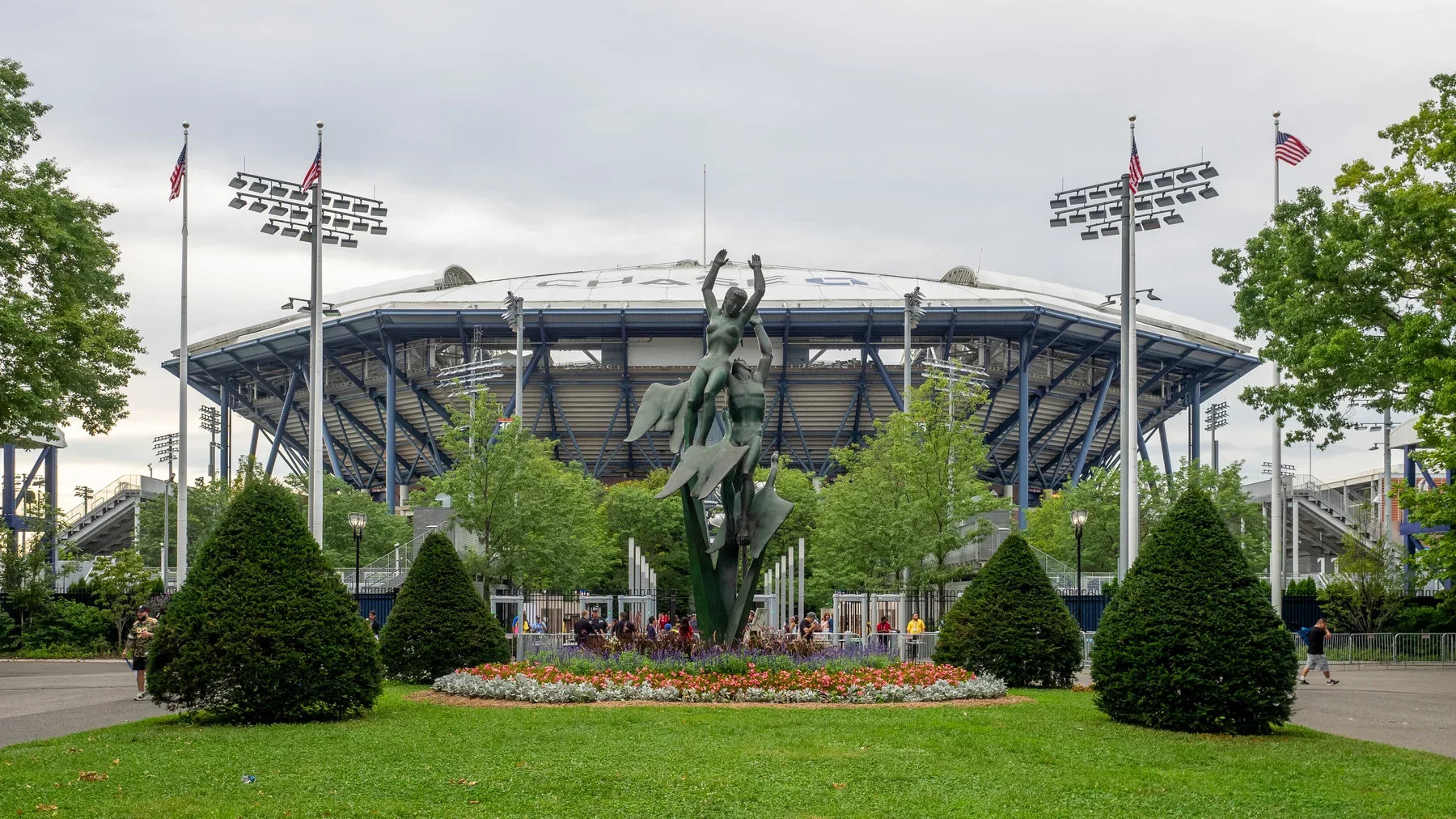
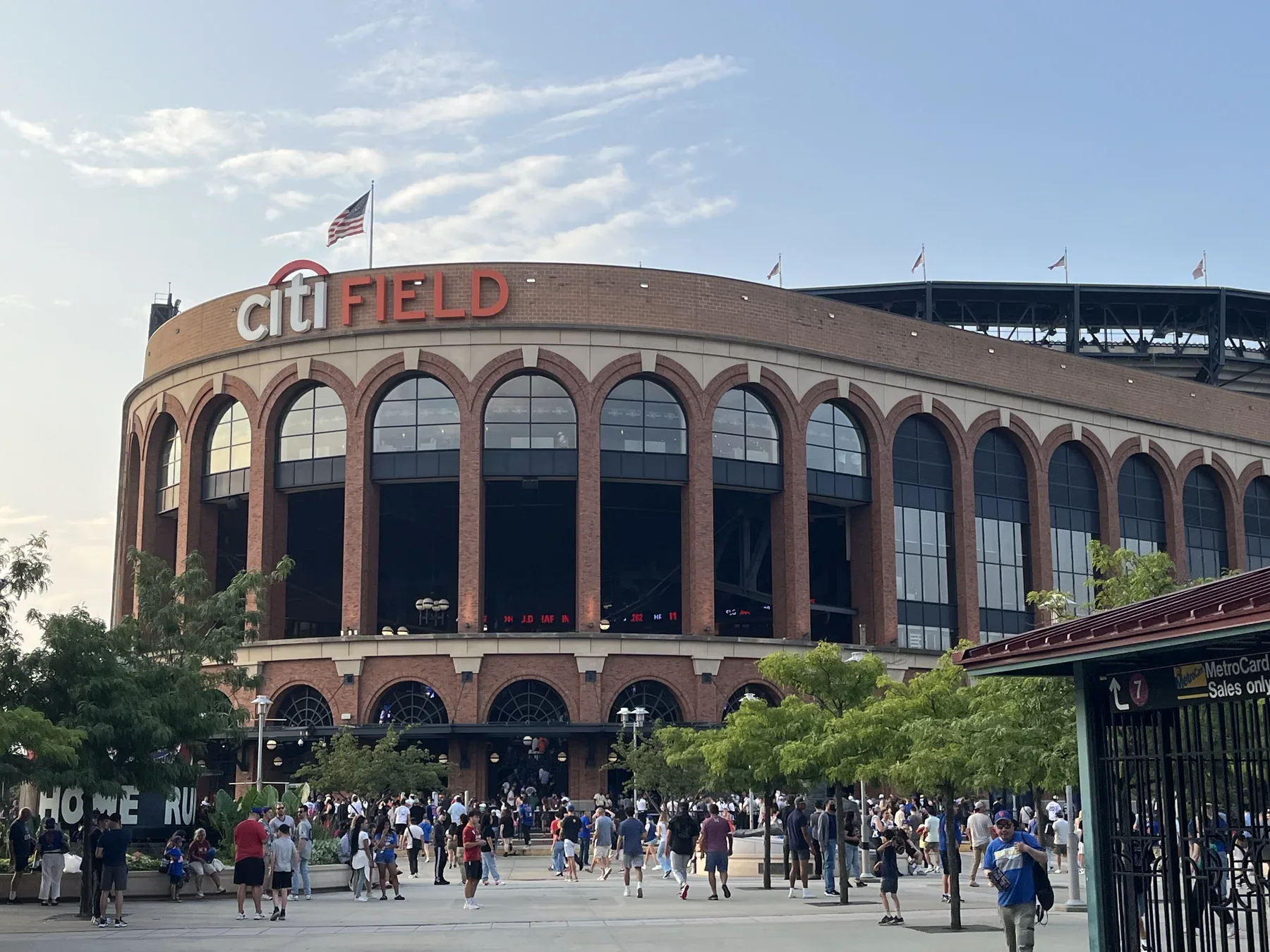
The archive photographs in this guide show real venue surroundings. They are illustrations, not parking maps or evidence that a particular gate, fence or path remains unchanged for a future tournament.
Parking near Citi Field depends on your date and pass
Parking is a date-specific decision. The tennis center and Citi Field share a busy neighborhood, and a Mets home game changes the demands on nearby roads and lots. Begin with your tennis session, then check the baseball calendar and the US Open's current parking instructions. A generic pin for “Citi Field parking” is not enough to establish where a tennis visitor should go.
Mets home games change the parking plan
Recent US Open guidance distinguishes non-conflict days, when stadium-area parking can serve tennis visitors, from conflict days with a Mets home game. The 2026 transportation guide at Tennis Overload describes the Yellow Zone for non-conflict parking and Blue and Orange areas for conflict arrangements. Treat these as a description of that edition, not a standing reservation or a confirmed 2027 allocation.
At the venue, follow event signs and traffic personnel. A route that appears shortest on a phone may point toward a restricted entrance or a lot already assigned to another event. Keep your parking confirmation accessible, and identify the name of the lot or operator before joining a vehicle queue. If you have a permit, its conditions matter more than the fact that the lot appears on a public diagram.
What to verify before paying for a space
SpotHero's parking overview distinguishes limited official parking from reservations at other nearby facilities. A private garage booking should be assessed as its own product. Check the exact street entrance, vehicle-height limit, arrival window, closing time and whether late retrieval is possible. For an evening session, “near the US Open” is less useful than a clear answer about collecting the car after a long match.
Compare the complete cost: parking, booking fees, tolls and any onward transport. Ask whether leaving and returning requires another payment. Do not assume a Mets parking purchase covers tennis, or that a tennis ticket includes parking. Our US Open ticket guide explains session access; parking remains a separate question.
No 2027 parking price is promised here. Before purchase, obtain the current rate and terms for your actual date. A slightly farther space with clear hours and a manageable pedestrian route can be a better choice than an attractive headline price whose access conditions remain uncertain.
Match your arrival route to the correct entrance
Your grounds entrance is an intermediate destination, not the end of the trip. Plan three stages: reach the station, parking space or designated drop-off; walk to the grounds entrance; then reach the court and seating area permitted by your ticket. Keeping those stages separate prevents a navigation app's arrival message from being mistaken for arrival at your seat.
From Mets-Willets Point to the Main Entry
The official March 2026 transport guide directs train passengers along the boardwalk to the Main Entry. Both the 7 subway and the LIRR serve Mets-Willets Point. Follow the tennis signs after leaving your platform, and allow for the walking and screening stages after the train journey ends.
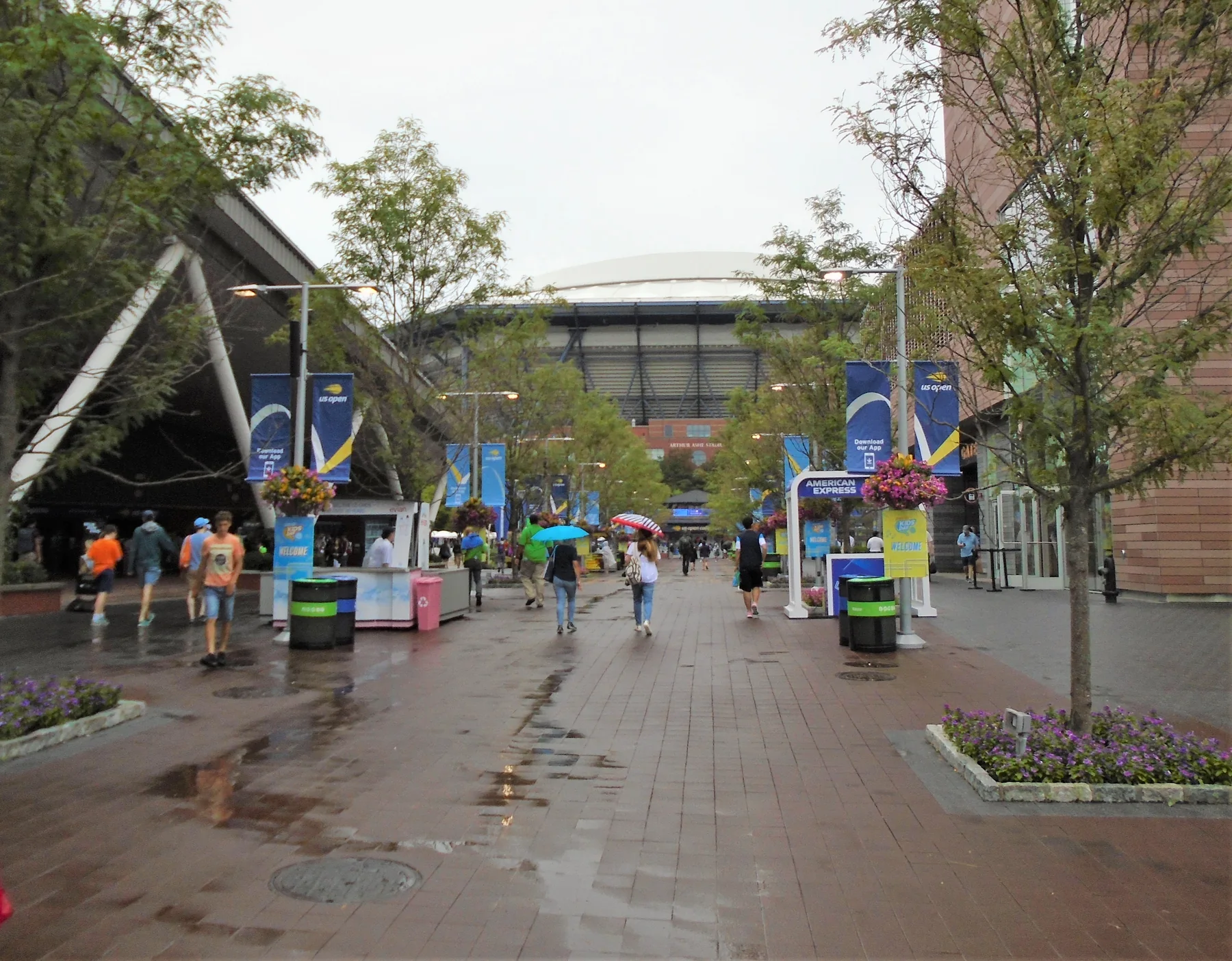
For general rideshare, that same 2026 official guide names the New York Hall of Science parking lot, with a walking connection to the Champions' Entry and assistance by shuttle. This is a dated description, not a guarantee for the next edition. Share the current approved pickup or drop-off location with the driver instead of asking to stop wherever the tennis center pin appears closest.
Older guides may use different gate names or describe a different car-service area. Some hospitality packages also have arrangements unavailable to ordinary ticket holders. Match the instructions to your own booking and the current public guide; a special-access description should never be treated as permission to drive through a restricted entrance.
Once inside, a grounds map tells you where a stadium is, while your ticket determines which seating you can use. Our grounds pass guide explains those distinctions for the 2026 edition. A reserved stadium seat and general grounds access are different entitlements even when their holders enter through the same grounds gate.
For a group, choose one recognizable meeting point after screening. “At the entrance” can mean opposite sides of a large queue. A named sign or agreed amenity is clearer, especially if people arrive by different transport modes.
Accessibility needs a route check before the trip
A successful accessible visit depends on the whole journey: vehicle or platform, path, screening, stadium circulation and seat. A parking symbol or a short distance on a map cannot confirm all of those stages. Start with the US Open's official accessibility information and describe the assistance you need before committing to a route.
Parking access is separate from seating access
Confirm the documentation needed for accessible parking and whether your particular parking product permits entry to the relevant area. An accessible seat reservation does not by itself explain the parking arrangement. Equally, a parking placard does not determine which stadium seats are included in a ticket. Resolve both questions independently.
Ask where the accessible shuttle boards, where it stops, its operating period and how to return after your session. If someone in your party uses a mobility device, describe it when checking suitability. Avoid building the plan around an unverified assumption that any shuttle can accommodate every device or that a service runs until any possible finishing time.
Also identify the distance and surface between the shuttle stop and the entrance. A nominally nearby lot may still involve a route that is unsuitable for a particular visitor. The useful answer is the complete path and available assistance, rather than a claim that one lot is universally “best.”
Check the station and the complete walking route
The MTA's Mets-Willets Point area guide states that the LIRR station is not accessible. Its subway guidance describes an event-time accessible exit from the Flushing-bound platform. These are different stations and different arrangements despite sharing the same place name. Do not choose the LIRR solely because a map shows it close to the tennis center.
The MTA guide also describes a different Manhattan-bound accessible journey using Flushing-Main Street. Because that page addresses Citi Field events, verify the operating arrangement for your tennis date with the MTA and station staff. An inbound route that works in daylight does not automatically answer the return journey after a night session.
Use the MTA accessibility hub for accessible trip planning, station information and elevator status. Check again on the day. Build a practical alternative if a lift or planned connection is unavailable, and share that alternative with your companions before entering the tournament.
Plan the trip home before a night session starts
A night-session ticket provides admission to tennis, not a guaranteed departure time. Build the return journey before taking your seat. Our explanation of why US Open matches finish late shows how match length and the preceding court schedule can push an evening beyond the time a visitor expected.
If you drive, photograph the lot identifier and a recognizable nearby landmark when you park. Keep the operator's contact details and retrieval instructions with the booking. A large event parking area can look quite different after dark, particularly when you return through a different exit. A clear location record is more useful than remembering that the car was “near the stadium.”
For a private garage, establish the latest retrieval time and the policy if your session runs over. Do this before paying. If a reservation requires an estimated exit time, allow for uncertainty and check whether extensions are possible. The tournament's continuing play does not automatically extend a separate parking agreement.
For rail, check the complete journey in current MTA information: departure from Mets-Willets Point, any transfer and the last leg to your accommodation. The MTA's area guide makes clear that event-related train handling does not necessarily protect onward connections. Do not assume a connecting train will wait because your match finished late.
Pay attention to the calendar date after midnight. A Friday evening session can produce a Saturday morning journey. Search the timetable for the actual departure time, including planned weekend work, rather than repeatedly checking Friday's afternoon services. The same principle applies to a car reservation whose date changes at midnight.
For rideshare, agree on a meeting point within the currently designated pickup area and confirm the vehicle before separating from your group. Avoid requesting a car while still far inside a stadium: a driver arriving first may be unable to wait where you expected. Keep enough phone power for tickets, navigation and communication throughout the return trip.
Finally, decide what your group will do if the last match outlasts its preferred travel option. Leaving at an agreed time or switching to a verified alternative is easier when discussed beforehand. That decision can protect the enjoyment of the evening instead of turning the final set into a frantic transport search.
What to recheck when the next US Open map appears
Use 2026 information as a dated baseline, then replace it with the next edition's instructions when published. This matters particularly during construction. The USTA's August 2026 transformation update described temporary arrangements during work on Arthur Ashe Stadium and planned completion by the 2027 US Open. A planned completion date is not evidence that every entrance and amenity is already in its final configuration.
Nearby development also needs careful interpretation. The Metropolitan Park project's transport discussion describes a future vision for parking and access around Citi Field. That vision does not tell a tennis ticket holder which lot will accept their car on a particular date. Use a tournament operating plan and the actual parking provider's terms for that decision.
Before booking, settle your session, transport mode and any access needs. Then verify that the parking product covers the intended date and duration. If the next US Open has not yet published its arrangements, leave room in your plan to choose a different route. An old map can help locate Queens landmarks, but cannot reserve future space or confirm a future shuttle.
During the week of your visit, check the latest grounds map and transport page together. Look specifically for changed entrance names, rideshare locations, permit restrictions and walking connections. Review the Mets home schedule and current transit service information. Replace old saved screenshots so that companions are not following different versions of the same route.
On departure day, make one final operational check. Confirm your ticket is accessible on the phone, the parking confirmation identifies the correct operator, and the return plan still works. Allow time for the approach, the pedestrian leg, screening and the walk to your seat. Treat any estimated road arrival as the start of those remaining stages.
The most useful map is therefore the one matched to a real decision. Use the transport map to get close, the grounds map to find your entrance and court, and the seating map to locate your section. With those roles clear, changing a parking plan becomes a manageable adjustment rather than a reason to lose the opening games.
Loading comments…