Novak Djokovic at the US Open: Titles, Finals and Career Record
Novak Djokovic has four US Open titles and ten final appearances. Review every championship match, the defining turning points and his career record through the 2026 tournament.
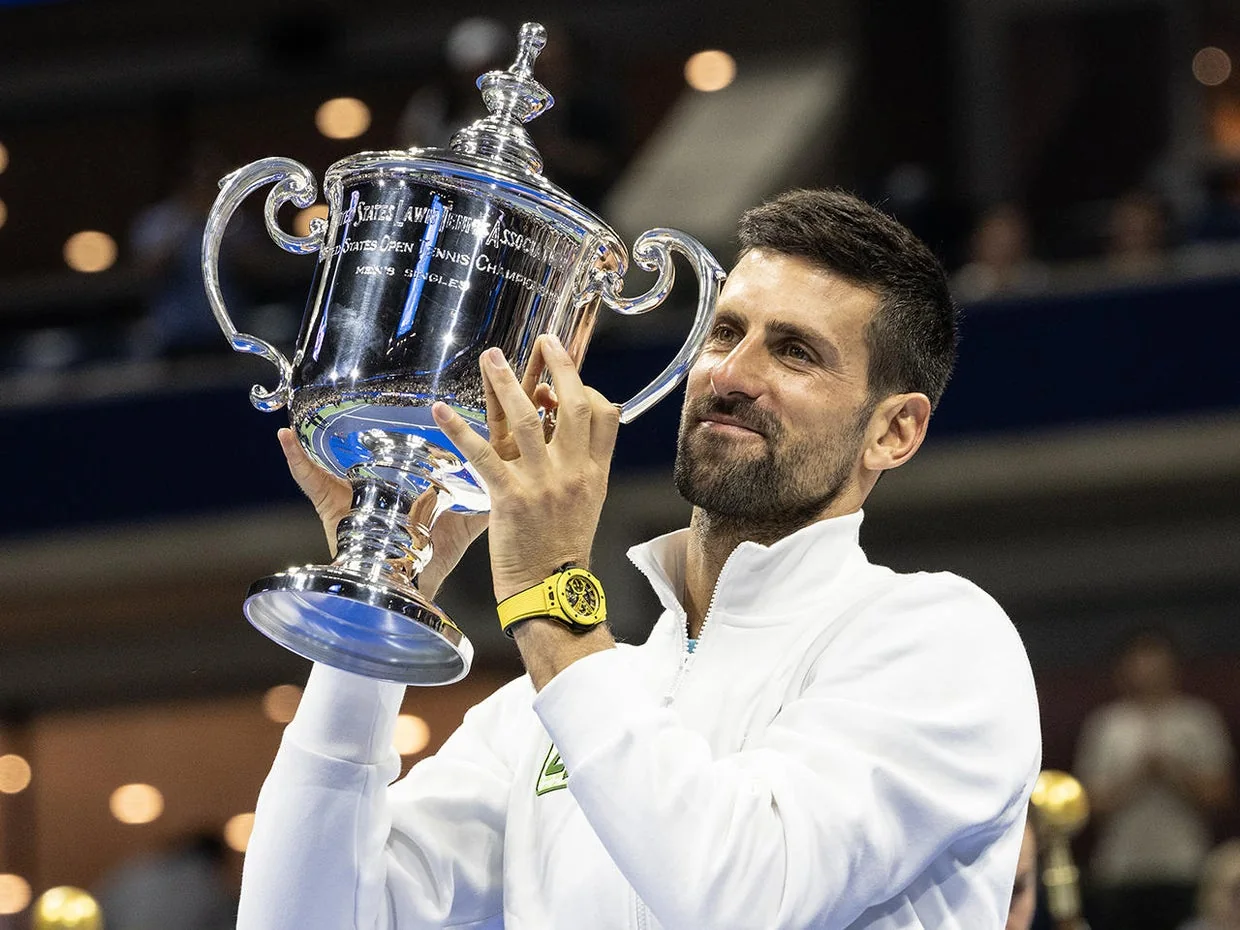
Djokovic's US Open record through 2026
Novak Djokovic has won four US Open men's singles titles: 2011, 2015, 2018 and 2023. He has played ten finals, winning four and losing six. His 2026 first-round defeat to Mariano Navone came in his 20th US Open appearance. This career review is updated through October 19, 2026.
Four championships
Four different final opponents: Rafael Nadal, Roger Federer, Juan Martin del Potro and Daniil Medvedev.
Ten finals
Four wins and six runner-up finishes, a record of sustained success that stretches beyond his title years.
Those two headline numbers need to be read together. Four titles establish Djokovic as one of the tournament's major champions. Ten finals show how often he put himself in position to add another. A final conversion rate of four in ten does not describe the many rounds he had already won to get there, just as a list of trophies leaves out the six occasions when someone else stopped him at the last hurdle.
He reached 95 US Open match victories by beating Taylor Fritz in the 2025 quarterfinals. The semifinal defeat that followed, then the opening loss in 2026, left that win total unchanged. The match-count explanation later in this guide separates victories actually played from advancement by walkover, a useful distinction when comparing tournament appearances with the number of rounds reached.
For the broader championship landscape, the US Open winners-by-year guide places his victories beside other champions. Here, the focus is Djokovic's own New York career: the opponents he beat, the finals he lost and the particular matches that explain how he built that record.
The four US Open titles, year by year
Djokovic's title years tell four different stories. The sequence begins with a first breakthrough in New York, passes through a period of sustained dominance and a return from injury, then reaches a championship won at 36. These were separate campaigns, with different opponents and pressures.
2011: Beating Nadal for a first New York title
Djokovic defeated Rafael Nadal, 6-2, 6-4, 6-7(3), 6-1, to win his first US Open. Nadal had beaten him in the previous year's final, so the result reversed an immediate piece of tournament history. Nadal extended the match by taking the third-set tiebreak, but Djokovic answered emphatically in the fourth.
The win made his earlier runner-up appearances part of a longer progression rather than the limit of his New York career. Reaching a final had become winning one, against the same opponent who had denied him a year earlier.
2015: A second crown against Federer
His second title came against Roger Federer, 6-4, 5-7, 6-4, 6-4. The four-year gap between crowns is a useful corrective to any impression that Djokovic simply collected the event every season at his peak. Returning to championship matches and winning them were different tasks.
The 2015 US Open was also part of his run toward holding all four major titles across 2015 and 2016. That achievement spans two seasons; it should not be confused with winning all four within one calendar year.
2018: The return to the winner's circle
Djokovic beat Juan Martin del Potro, 6-3, 7-6(4), 6-3, for title number three. He had missed the 2017 tournament, and his 2018 season included elbow surgery before he returned to winning major championships at Wimbledon and the US Open.
The official 2018 final report describes the depth and variety that kept del Potro under pressure. This was a restored championship level, rather than a title successfully defended from the previous year.
2023: A fourth title at 36
The fourth crown arrived against Daniil Medvedev, 6-3, 7-6(5), 6-3. At 36, Djokovic became the oldest men's singles champion of the US Open's Open Era. The milestone was about both longevity and the ability to solve a demanding match.
His title years therefore resist a single explanation. Some were breakthroughs or returns; another extended a mature champion's career. Taken together, they show why the four trophies matter beyond their place in a simple total.
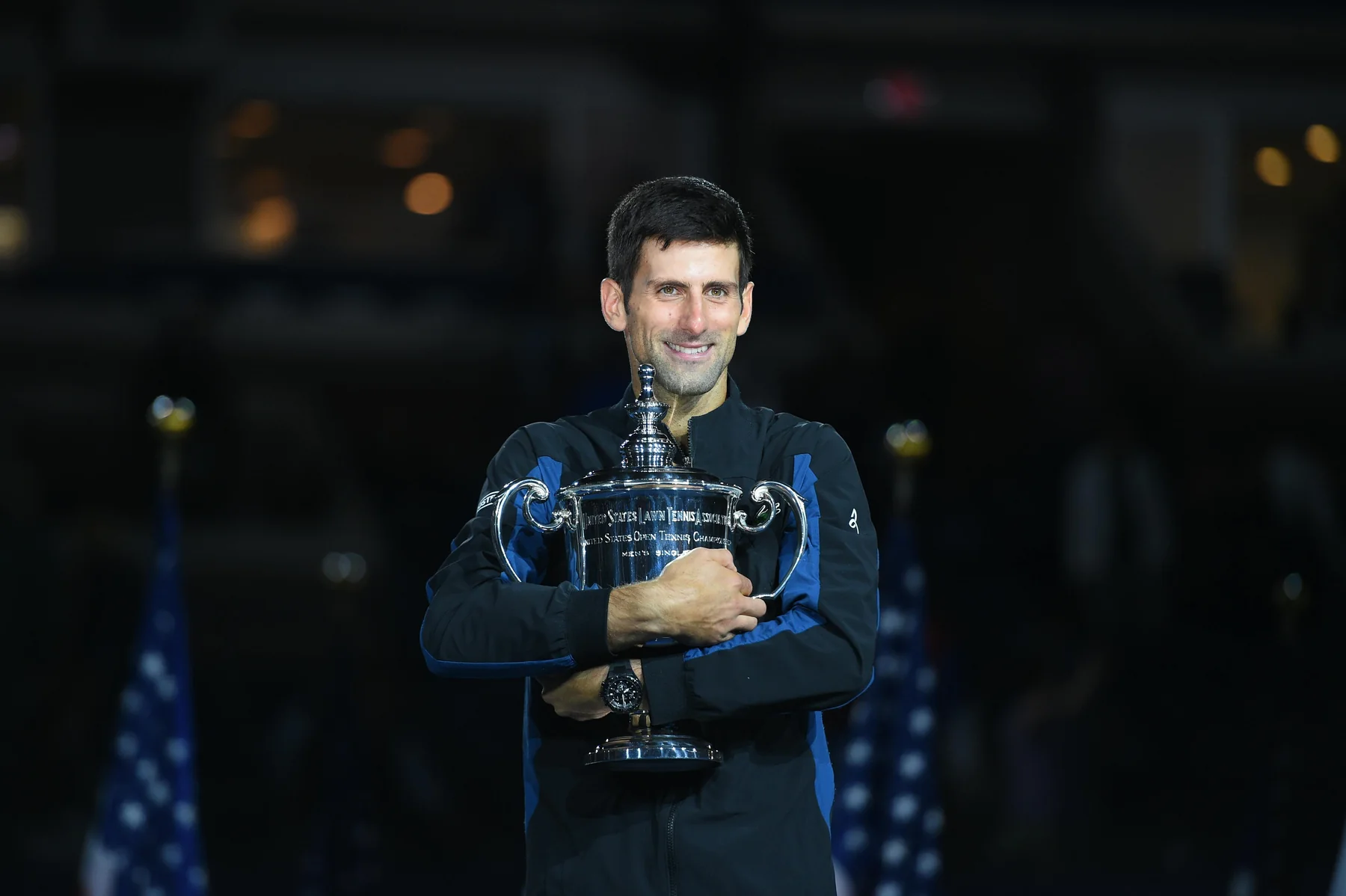
All ten Djokovic US Open finals
Djokovic has reached ten US Open men's singles finals, with four victories and six defeats. Every score below is written from the champion's perspective. The result column separately identifies whether Djokovic won the title or finished runner-up.
| Year | Champion | Djokovic's result | Final score, champion first |
|---|---|---|---|
| 2007 | Roger Federer | Runner-up | 7-6(4), 7-6(2), 6-4 |
| 2010 | Rafael Nadal | Runner-up | 6-4, 5-7, 6-4, 6-2 |
| 2011 | Novak Djokovic | Champion | 6-2, 6-4, 6-7(3), 6-1 |
| 2012 | Andy Murray | Runner-up | 7-6(10), 7-5, 2-6, 3-6, 6-2 |
| 2013 | Rafael Nadal | Runner-up | 6-2, 3-6, 6-4, 6-1 |
| 2015 | Novak Djokovic | Champion | 6-4, 5-7, 6-4, 6-4 |
| 2016 | Stan Wawrinka | Runner-up | 6-7(1), 6-4, 7-5, 6-3 |
| 2018 | Novak Djokovic | Champion | 6-3, 7-6(4), 6-3 |
| 2021 | Daniil Medvedev | Runner-up | 6-4, 6-4, 6-4 |
| 2023 | Novak Djokovic | Champion | 6-3, 7-6(5), 6-3 |
The ten appearances are an Open Era men's record. Across the tournament's full history, Djokovic shares the ten-final total with Bill Tilden, whose career belongs to an earlier era. Keeping that distinction explicit avoids turning an Open Era record into a claim that nobody in any period reached as many finals.
The defeats also deserve their own identities. Federer, Nadal, Murray, Wawrinka and Medvedev beat him in championship matches. That is a range of opponents and styles across a long career, not one repeated matchup producing all six losses. Nadal accounts for two of those defeats; Federer and Medvedev each appear on both sides of Djokovic's title story.
A final win percentage can summarize conversion, but it cannot explain every final. The opponent, the path through the draw and the match itself all matter. For a wider view of championship matches, the site's US Open finals page supplies the tournament context. Djokovic's own table is most useful as a map to the individual contests, rather than a substitute for understanding them.
Why the title runs were decided before the final too
A championship list begins with the trophy, but a title run can nearly disappear several rounds earlier. Djokovic's New York career offers a famous example of survival before the final, followed by another example of managing repeated pressure inside the championship match itself.
The 2011 return that changed a semifinal
Against Federer in the 2011 semifinal, Djokovic came back from two sets down and saved two match points. The first was erased by a forehand return winner across court. He still had to save the next chance and win the remaining games; the shot kept the contest alive rather than ending it.
The official retrospective of great US Open semifinals puts that escape inside the title campaign that followed. Without it, there is no Djokovic-Nadal final and no first New York trophy. The semifinal belongs in an explanation of his championships even though it never appears in a table of final scores.
It is tempting to turn one extraordinary return into a general lesson that taking the biggest possible risk always works. The evidence supports a narrower conclusion: on that point, under that pressure, Djokovic committed to a shot and executed it. The rest of the comeback still required more successful tennis.
The 2015 final rewarded break-point defense
The 2015 Federer final illustrated a different route. Federer converted only four of 23 break-point opportunities, meaning Djokovic saved 19. The count measures opportunities, not 23 separate service games; several chances can occur within one game.
That distinction also improves the interpretation. Djokovic did not avoid every difficult situation. He repeatedly got through enough of them to prevent Federer's pressure from deciding the match. A memorable single winner and a long series of successful pressure points can both help produce a title, but they are different achievements. Recognizing the difference makes his New York record more interesting than a generic claim that he always played his best when it mattered.
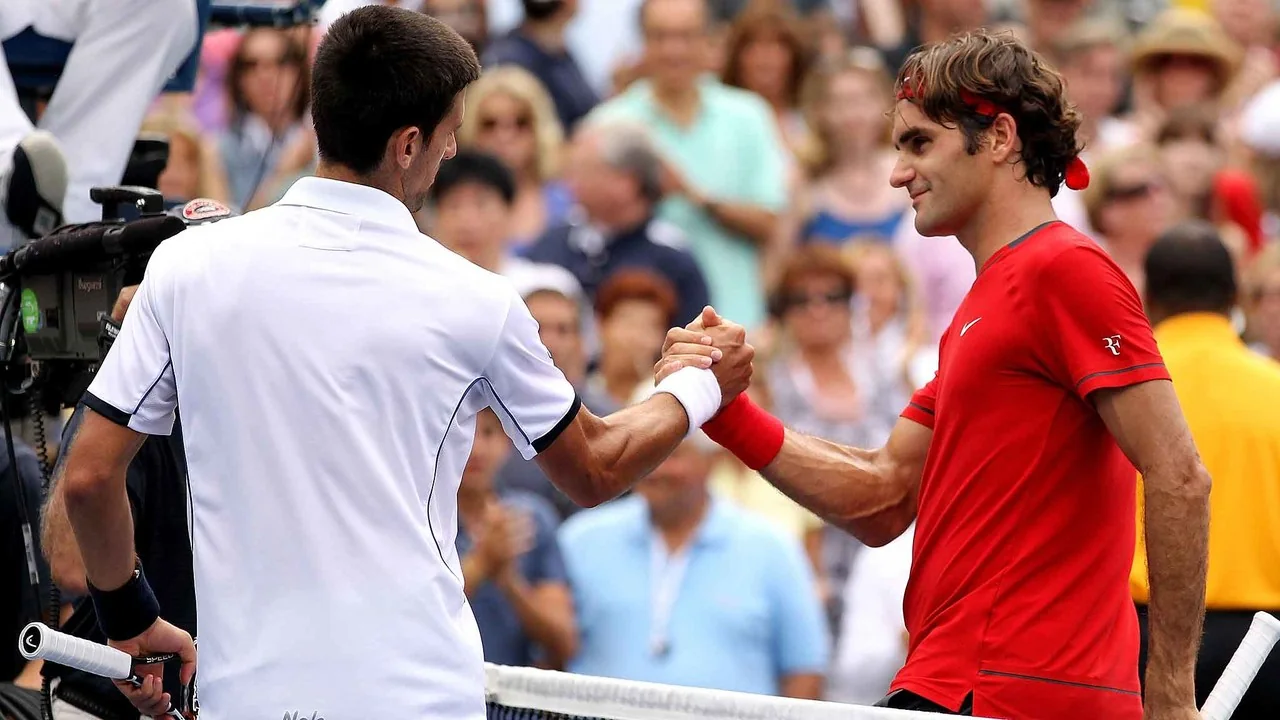
Medvedev exposed the challenge in 2021 and the adjustment in 2023
Medvedev beat Djokovic, 6-4, 6-4, 6-4, in the 2021 final, denying him the calendar Grand Slam at the last match. Two years later, Djokovic won their next New York championship meeting in straight sets. The same opponent and two apparently decisive scorelines produced very different outcomes.
The 2021 defeat belongs among the most consequential losses in Djokovic's US Open career because of what was at stake beyond the trophy. Winning every major within a single season is a different achievement from winning each major at some point during a career. Djokovic arrived at that final trying to complete the former; Medvedev prevented it.
Moving forward changed the 2023 contest
The official account of the 2023 final identifies a specific tactical answer to Medvedev's deep receiving position. Djokovic won 37 of 44 net points, including 20 of 22 serve-and-volley points. The serve-and-volley total sits within the net-play total; the two figures should not be added together.
Moving forward changed the question Medvedev had to answer. Instead of every point becoming another opportunity to establish a long baseline exchange, Djokovic could ask for a passing shot or make the returner deal with a volley. The statistics show that this approach produced points in that match. They do not establish that every future meeting should use exactly the same plan.
The second set also lasted 104 minutes and required Djokovic to save a set point. A straight-set victory can contain a passage in which the whole match is at risk of becoming much more difficult. That makes the 2023 final a useful illustration of adaptation under pressure, rather than merely a neat reversal of the 2021 score.
For anyone assessing his US Open record, this pair of finals is a reminder to look beyond the identity of the winner. One defeated a historic ambition; the other showed a practical way to alter a difficult matchup. Both are part of understanding the four-title career.
How to read Djokovic's career wins and losses
Using the official tournament's confirmed record checkpoints, Djokovic's US Open men's singles record through 2026 reconstructs to 95 wins and 16 losses. The 95th victory came against Fritz in the 2025 quarterfinals. He then lost to Alcaraz in that year's semifinal and to Navone in the 2026 first round, adding no further wins.
How the count is built: 95 officially reported victories remain 95 after two subsequent defeats. Twenty main-draw appearances, with four championship campaigns, leave 16 campaigns ending in a loss. This is a reconstruction from those dated official facts, including the defaulted 2020 match, rather than a quotation of a live player-profile total.
It is important not to calculate victories simply by assuming that every advance through a round required a played match. In 2016, Jiri Vesely withdrew before their second-round meeting and Djokovic advanced by walkover. That changed his place in the draw without adding a played-match victory. An opponent retiring after a match has started is a different outcome: Djokovic's third-round meeting with Mikhail Youzhny that year did begin, and counted as a win.
The default against Pablo Carreno Busta in 2020 also belongs in the loss column. That was an ongoing fourth-round match, not a withdrawal before the tournament or a walkover. The unusual ending should stay attached to the result rather than being silently replaced with an imagined completed score.
Absences are different again. Djokovic did not play the event in 2017 or 2022; those years add neither a main-draw match victory nor a defeat. The figures here concern men's singles at the US Open, excluding doubles, exhibitions and unrelated tour matches.
This counting method makes the career easier to compare honestly. A draw records who advanced, while a match record records wins and losses under the relevant outcome conventions. The US Open results pages are useful for individual contests; retaining the walkover, retirement or default label is essential when those contests are added into a career total.
The 2026 result updates the record without defining the career
Djokovic's latest US Open result was a first-round loss to Mariano Navone on August 30, 2026. Navone won, 7-6(5), 5-7, 4-6, 6-2, 6-1, in Arthur Ashe Stadium. It was Djokovic's first opening-round defeat in 20 appearances at the tournament.
The match lasted four hours and 36 minutes, and Djokovic described physical difficulties afterwards. Those details help explain the immediate contest, but they do not justify inventing a diagnosis or treating the result as a retirement announcement. The full match is covered separately in our Djokovic-Navone 2026 US Open recap.
For the career record, the change is straightforward: another appearance and another defeat, with no additional title or final. For an assessment of his current competitive level, it raises a different set of questions about sustaining performance through a demanding major. Keeping those questions separate prevents the latest match from rewriting the history that came before it.
A future appearance needs its own confirmation
A wave to the crowd after a difficult defeat is not enough to establish that a player has made his final appearance. Equally, a long history of returning to New York is not confirmation of a place in the next edition. An entry, a draw position and a scheduled match are separate steps, each requiring its own announcement.
When a future edition approaches, use confirmed tournament information and the daily Order of Play for actual court assignments and times. A historical record cannot tell a ticket holder when a player will next walk onto Ashe.
As of this review's cutoff, the reliable New York picture remains four titles, ten finals and a completed 2026 first-round exit. The titles explain what Djokovic achieved; the final table shows how often he reached the last match; the latest result describes where this particular campaign ended. Each measure answers a different fan question, and the strongest account of his US Open career keeps all three in view.
Loading comments…