2026 US Open Juniors: Winners, Results, Draws and Schedule
Marcel Latak and Sun Xinran won the 2026 junior singles titles. Explore all four finals, the doubles champions, key match details and the official junior draw archives.

The 2026 US Open junior championships are complete. This retrospective brings together the four singles and doubles finals, the September schedule and official draw links, with facts checked October 19, 2026.
Who won the 2026 US Open junior titles?
Marcel Latak and Sun Xinran won the boys' and girls' singles titles at the 2026 US Open. Annika and Kristina Penickova took girls' doubles, while Aaron Gabet and Valentin Gonzalez-Galino won boys' doubles. All four finals were completed on Saturday, September 12, in New York.
| Event | Champions | Runners-up | Final score |
|---|---|---|---|
| Boys' singles | Marcel Latak | Guto Miguel | 3-6, 7-5, 7-6(13) |
| Girls' singles | Sun Xinran | Anna Pushkareva | 6-4, 4-6, 6-0 |
| Boys' doubles | Aaron Gabet / Valentin Gonzalez-Galino | Tanishk Konduri / Marcel Latak | 7-6(5), 2-6, [11-9] |
| Girls' doubles | Annika Penickova / Kristina Penickova | Polina Berezina / Alisa Terentyeva | 7-6(11), 6-3 |
Scores are shown from the winners' perspective. Parentheses after a 7-6 set identify the losing side's tiebreak points; square brackets identify the deciding match tiebreak used in doubles. Consequently, the boys' singles and boys' doubles finales were different kinds of deciding contests, even though both required the winners to keep playing beyond an initial tiebreak target.
This is a completed-results guide to the four boys' and girls' singles and doubles championships. Junior wheelchair tennis belongs to a separate competition program, and these names should not be substituted for its champions. Nor are these the winners of the senior singles or doubles tournaments: the junior event has separate draws and eligibility conditions.
The table gives the destination, but the route is what made this edition distinctive. Latak recovered from losing the opening set against the top seed, then returned for another final. Sun had to put two earlier major-final defeats behind her. The girls' doubles champions settled a demanding opening tiebreak before completing a straight-sets victory, while the boys' doubles trophy remained in doubt through a deciding 11-9 finish.
For the professional championships, consult the separate US Open senior results. The sections below explain the junior finals and show how to find the corresponding 2026 draw records, with the event year and category kept explicit.
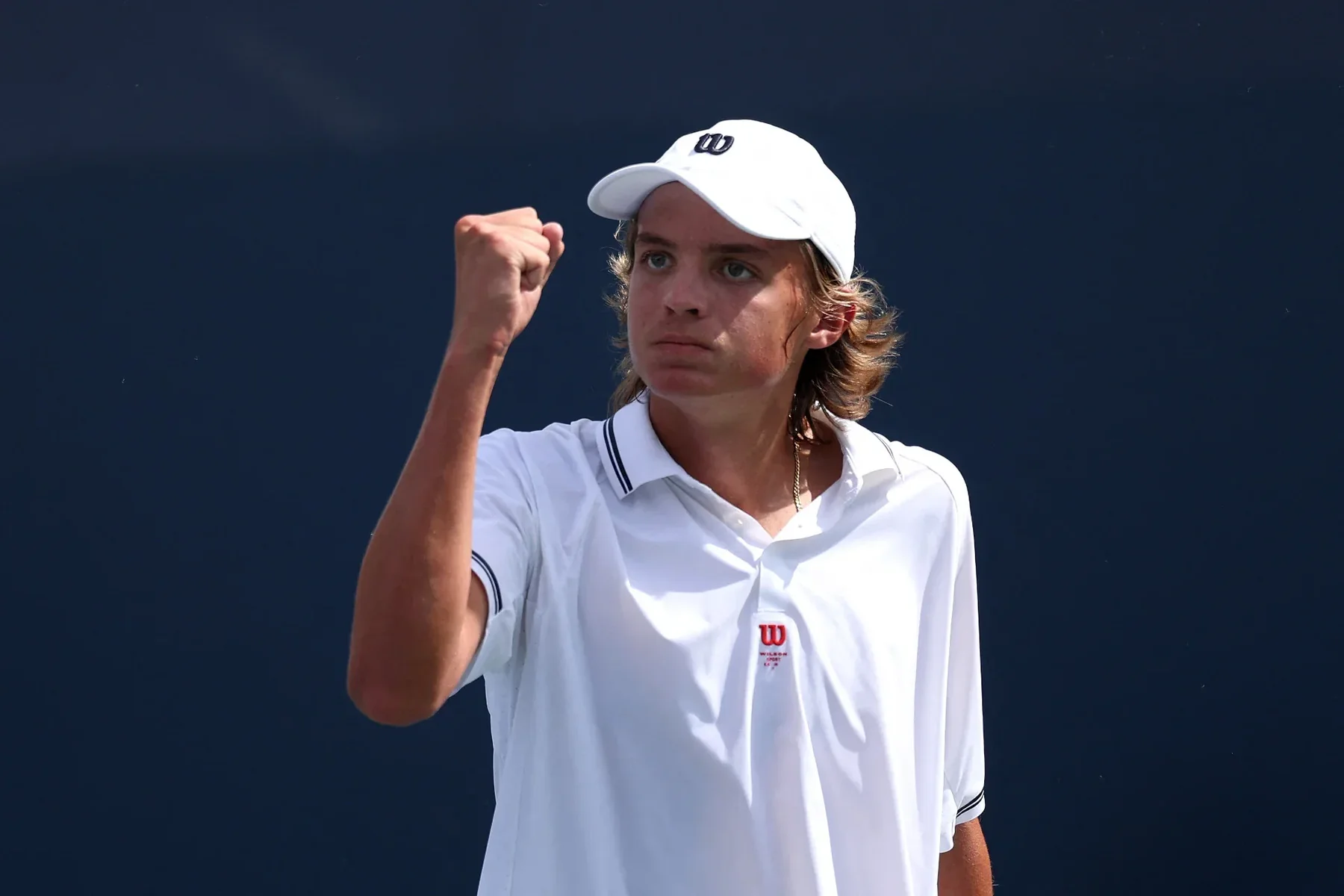
How Marcel Latak won the boys' singles final
Latak won by recovering from a set down and surviving an extended deciding tiebreak against top seed Guto Miguel. The final lasted two hours and 46 minutes. Its last decisive action was an attacking one: at 14-13 in the tiebreak, the American struck a deep crosscourt backhand winner to complete the comeback.
The opponent makes the result more significant than a simple home-crowd celebration. Miguel had already won the 2026 Roland Garros boys' singles title. Latak was unseeded and, according to the ITF's championship report, had never previously won a Junior Grand Slam match before this New York run. The final was not the predictable conclusion to an established sequence of major titles.
He also arrived with evidence that the breakthrough went beyond one fortunate afternoon. His semifinal win over No. 2 seed Jamie Mackenzie was 6-3, 7-6(2). The ITF described the championship match as his fourth victory over a Top 10 opponent during the tournament. That broader record is a better measure of the week than reducing the title to one spectacular backhand.
Why the final tiebreak mattered
The deciding score, 7-6(13), means a 15-13 tiebreak: 28 points in which the title could move within reach and then recede. Latak's own account described opportunities missed as well as championship points saved. A long tiebreak should not be rewritten as a smooth finish simply because the final score has a clear winner.
Our reading is that the final rewarded the ability to reset after a lost chance. The first set had already gone against him; the final phase demanded another response when earlier chances did not close the match. The concluding backhand matters because it shows how the trophy was actually secured, without requiring an invented total of winners or a claim that every rally followed the same pattern.
Latak became the first American boys' singles champion in New York since Taylor Fritz in 2015. That is specifically a junior record, distinct from the senior champions in our US Open winners history. He would also contest the doubles final later that day, adding another match to an already demanding finish.
Sun Xinran turned a third major final into a title
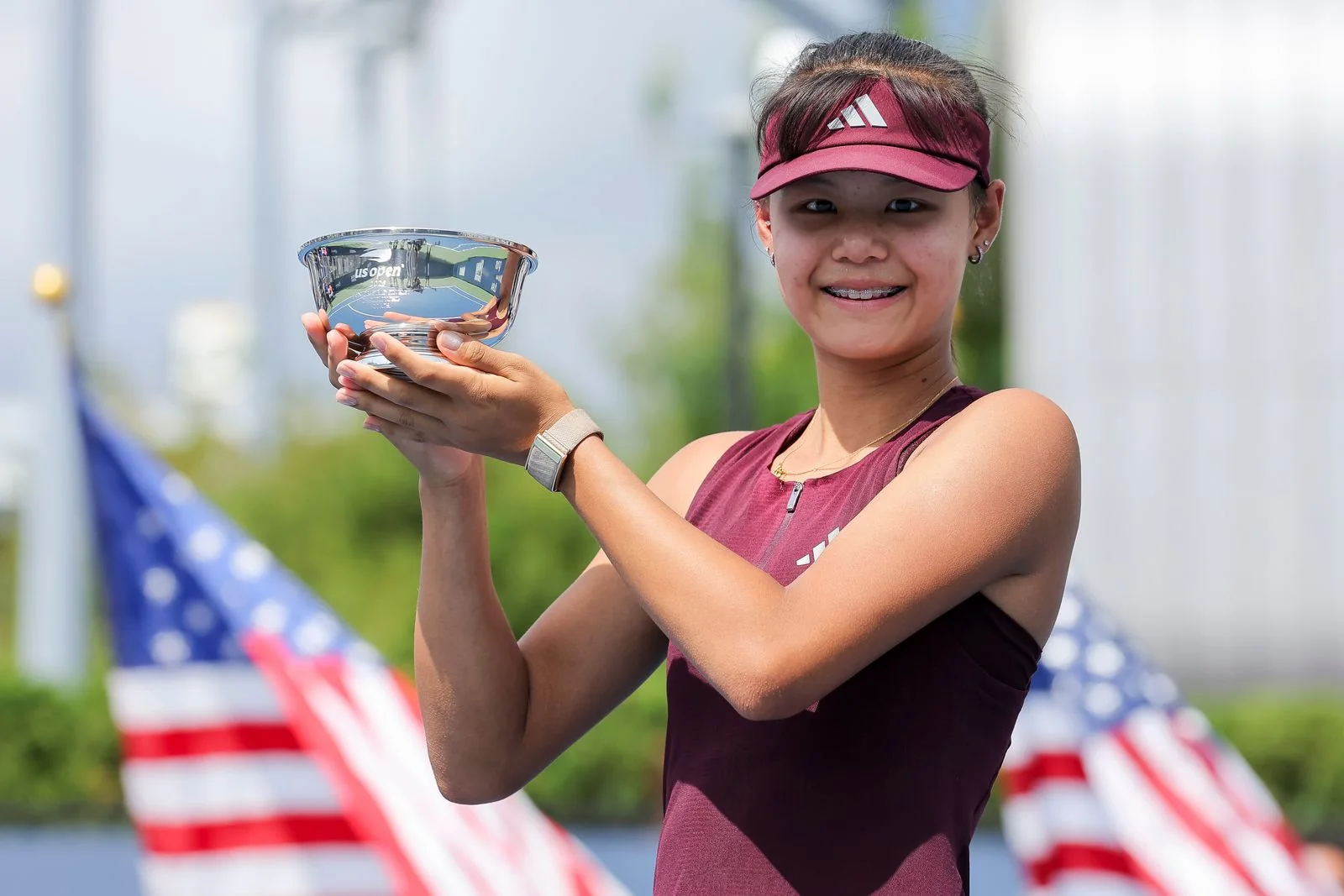
Sun's 6-4, 4-6, 6-0 victory over Anna Pushkareva was her first Junior Grand Slam singles title. At 16, the top seed had already lost the Roland Garros and Wimbledon finals that season. New York brought a third opportunity, including a rematch with the player who had beaten her in London.
The match lasted one hour and 47 minutes. After the first two sets mirrored each other at 6-4, Sun won every game of the third. The finish gave her a decisive scoreboard advantage, but it should not erase how evenly the opening two sets had divided the match.
The break-point contrast
The WTA's match report recorded Sun converting six of eight break points, compared with two of 10 for Pushkareva. Those are conversion rates of 75% and 20%. The same report listed 10 winners and 26 unforced errors for Sun, against 28 winners and 48 unforced errors for her opponent.
Read those columns together. Pushkareva hit substantially more winners, yet the cost of errors and the conversion of return opportunities favored Sun. That does not establish a permanent personality trait or prove that every break point was won in the same way. It does explain why the larger winners total failed to translate into the trophy.
A third set that changed the story
Sun's own explanation added a tactical point. In her post-final press conference, she described feeling too soft in the second set and deciding to play more aggressively in the third. This was her assessment of the adjustment, rather than an outside diagnosis of her opponent's confidence or fitness.
The USTA report counted three unforced errors for Sun in the deciding set, compared with 11 for Pushkareva. The useful reading is that a more positive intention did not require reckless hitting. She could take greater initiative while still making the opponent bear the larger error cost. The available figures support that interpretation without supplying a complete rally-by-rally explanation.
Sun's title belongs in the junior girls' archive. The senior women's singles draw is a different competition, and junior success should not be converted automatically into a professional ranking prediction. Here, the confirmed achievement is already substantial: she responded to two earlier final defeats and closed the third final with a 6-0 set.
Two contrasting junior doubles finals
The junior doubles finals showed why the word “tiebreak” needs context. The girls' championship included an extended tiebreak within the first set, while the boys' title required a separate match tiebreak after the first two sets were split. Both were tight contests, but the scoring structures produced different routes to the trophy.
The Penickova sisters won a long first-set tiebreak
Annika and Kristina Penickova defeated Polina Berezina and Alisa Terentyeva 7-6(11), 6-3. The opening tiebreak finished 13-11, after which the sisters completed the match without needing a deciding match tiebreak. It was their second Junior Grand Slam doubles title together, following the 2025 Australian Open.
Kristina also had a separate 2025 Wimbledon junior doubles title with Vendula Valdmannova. The word “together” therefore matters when counting the sisters' shared trophies. A player's individual doubles record and the record of a particular partnership can be different totals.
The first-set score supplies the main editorial point. A straight-sets win can contain a prolonged phase in which neither team has secured control. Once the Penickovas won that opening contest, their opponents still had another set in which to respond; the 6-3 second set completed the job. The score does not justify inventing a specific volley pattern or assigning every important point to one sister.
Gabet and Gonzalez-Galino stopped Latak's double bid
Aaron Gabet and Valentin Gonzalez-Galino beat Tanishk Konduri and Marcel Latak 7-6(5), 2-6, [11-9]. The official boys' doubles draw records that complete score. The French-Spanish partnership won the opening set, lost the second and then recovered to claim the deciding phase.
The USTA's account described their match-tiebreak leads of 5-1 and 8-4 becoming 9-all before they won the final two points. A lead in this format can disappear quickly; at 9-all, the earlier advantage no longer removed the need for a two-point finish. That makes the closing response as important as the initial burst.
Latak thus finished with one title and one runner-up result. He had played a lengthy singles final earlier, but the record alone does not establish why any particular doubles point was lost. Credit the doubles winners for securing their own championship rather than treating the match as an appendix to his singles story. For other categories, the US Open draw overview keeps the senior competition separate.
The 2026 junior schedule and official draw links
The 2026 junior singles main draw ran from Sunday, September 6, through Saturday, September 12. Doubles began on Monday, September 7. Junior singles qualifying had already taken place on September 3-4 at the Cary Leeds Center for Tennis & Learning, according to the USTA junior player guide.
| Competition stage | New York dates | Reading note |
|---|---|---|
| Junior singles qualifying | September 3-4 | Cary Leeds venue; separate from senior qualifying |
| Junior singles main draw | September 6-12 | Boys' and girls' draws |
| Junior doubles main draw | September 7-12 | Boys' and girls' team draws |
| All four finals covered here | September 12 | Completed championship matches |
These are historical dates, not a live schedule and not an announcement for 2027. The separate junior wheelchair program was listed for September 9-11. A generic tournament range can therefore be misleading if it combines several competitions into one date line.
For the completed brackets, use the dated official PDFs: 2026 boys' singles, 2026 girls' singles, 2026 boys' doubles and 2026 girls' doubles. Each is a different event; the year and the category in the file name are useful safeguards when revisiting the archive.
The singles fields contained 64 players, while each doubles draw contained 32 teams. Read a player's line forward through the rounds rather than treating nearby scores in extracted PDF text as an ordinary list. The diagram's spatial arrangement connects opponents and winners; plain text can lose that relationship.
A draw also answers a different question from an Order of Play. It shows progression and results, while a daily court list identifies when and where a scheduled match belongs. Our US Open Order of Play overview provides the senior tournament context. For a junior match, select its explicitly named category in the official archive, confirm the day's court assignment and distinguish a scheduled start from a completed result.
What these results tell us about the next generation
The 2026 junior results identify players who handled a demanding championship week. They do not, by themselves, forecast the next senior US Open winner. The most useful follow-up is to watch how the same players perform when the opponent, surface, match format or level of competition changes.
Latak's breakthrough had a coaching context as well as a dramatic finish. The ITF report named Christian Groh as his coach and noted Groh's previous work with Taylor Fritz, Tommy Haas and Brandon Nakashima. That background helps explain the development environment, but it does not make those established players' career paths a template that Latak must follow.
Sun had already taken steps in professional tennis before this junior title, including two W15 titles in October 2025, as recorded by the ITF. Her New York win therefore sits alongside a developing professional record. Fans should track those records separately, with the date and competition level attached to any ranking or result they quote.
The finalists' choices can also differ. In the ITF's September 12 account, Miguel described this as his last junior tournament. That statement concerned a transition away from junior competition, not retirement from tennis. A player can move toward the professional circuit without first collecting every available junior trophy.
For readers following the junior season beyond New York, the 2026 World Tennis Tour Junior Finals were scheduled for October 21-25 in Chengdu, with eight boys and eight girls. As of this guide's October 19 check, that event was still ahead. Its field and results should be checked in its own listing rather than inferred from the US Open champion table.
Our editorial focus is repeatability. Does a player protect a second serve when the first serve stops landing? Can a doubles pair regain its shape after losing a lead? Can the returner create another chance after missing a break point? Those are questions to test in subsequent matches, not qualities to assign permanently on the evidence of one highlight.
The senior US Open player directory becomes useful when those prospects enter the professional championship. Until then, this edition already has its own clear record: two singles champions, two doubles partnerships and four finals that rewarded different forms of recovery under pressure.
Loading comments…