Serena Williams and Carlos Alcaraz at the 2026 US Open: Mixed Doubles Results and What Happened
A match-by-match account and tactical analysis of Serena Williams and Carlos Alcaraz in the 2026 US Open mixed doubles event.
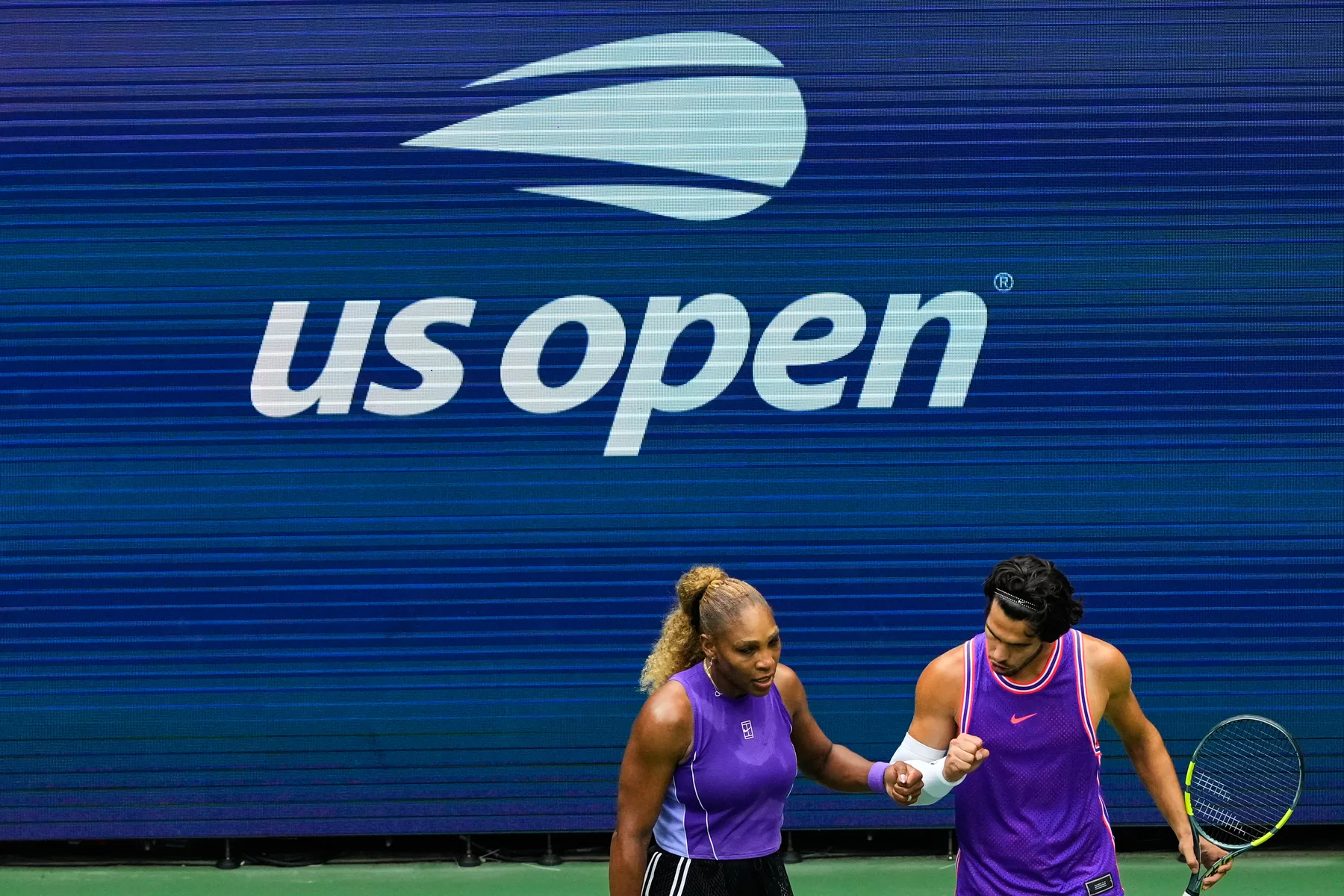
Serena Williams and Carlos Alcaraz finished their 2026 US Open mixed-doubles run in the quarterfinals. They beat Erin Routliffe and Lloyd Glasspool before Belinda Bencic and Flavio Cobolli ended the partnership's first tournament together. This is the completed account, updated through August 26, with both scores, the tactics behind the swing and the wider meaning of two generations sharing Arthur Ashe Stadium.
What Was the Serena Williams and Carlos Alcaraz US Open Result?
Serena Williams and Carlos Alcaraz reached the quarterfinals of the 2026 US Open Mixed Doubles Championship. The wild-card pairing beat Erin Routliffe and Lloyd Glasspool 5-3, 4-1 in the first round on August 25, then lost 5-4(4), 4-1 to Belinda Bencic and Flavio Cobolli later the same day. That gives the partnership a completed record of one win and one defeat. It was a memorable return, not a title run, and any preview that still lists their quarterfinal as an upcoming match is now out of date.
| Round | Opponents | Result | Score |
|---|---|---|---|
| Round of 16 | Erin Routliffe / Lloyd Glasspool | Won | 5-3, 4-1 |
| Quarterfinal | Belinda Bencic / Flavio Cobolli | Lost | 5-4(4), 4-1 |
The symmetry in those scorelines is revealing. Williams and Alcaraz finished their opening match by taking the second set 4-1, yet Bencic and Cobolli returned the same margin in the quarterfinal. In sets played only to four games, there is almost no recovery lane: one loose service game or one poor return game can create the equivalent of a two-break deficit in a conventional set. The first-set tiebreak against Bencic and Cobolli was therefore the hinge of the day. Once it went the other way, Williams and Alcaraz had to chase immediately rather than settle into a longer match.
Both matches took place in Arthur Ashe Stadium, which made the pairing feel bigger than an ordinary first-day doubles story. Williams was back at the US Open after last appearing in 2022, while Alcaraz was playing his first competitive event since a right-wrist injury interrupted his season in April. The atmosphere and the names created a headline, but the draw did not offer exhibition-level resistance: Routliffe and Glasspool arrived as proven doubles players, and Bencic and Cobolli advanced with a disciplined 55-minute win.
For the live tournament picture beyond this completed run, use the US Open results hub. The essential verdict here is clean: Williams and Alcaraz supplied one electric victory, reached the last eight and were then beaten by the more settled team in the decisive phases.
How Williams and Alcaraz Won Their First Match
Williams and Alcaraz won their opener by surviving the untidy phase, then making the court feel smaller for two established doubles players. Alcaraz began his competitive return with a double fault and the new partnership initially looked exactly that: new. Their spacing was not automatic, their service patterns had not been rehearsed through a season, and Routliffe and Glasspool had already played two qualifying matches together. The specialists took the early initiative. What changed was not a sudden burst of singles-style winners so much as a cleaner division of labor.
Williams gave the pairing a stable base. Her return remains compact, early and difficult to read, an ideal shape when there is less time in doubles. At net, her presence discouraged opponents from using comfortable crosscourt targets. Alcaraz could then use his acceleration from the back and his speed closing forward without having to manufacture every point. That combination helped turn a slow opening into a 5-3 first set and made the 4-1 second set markedly more controlled.
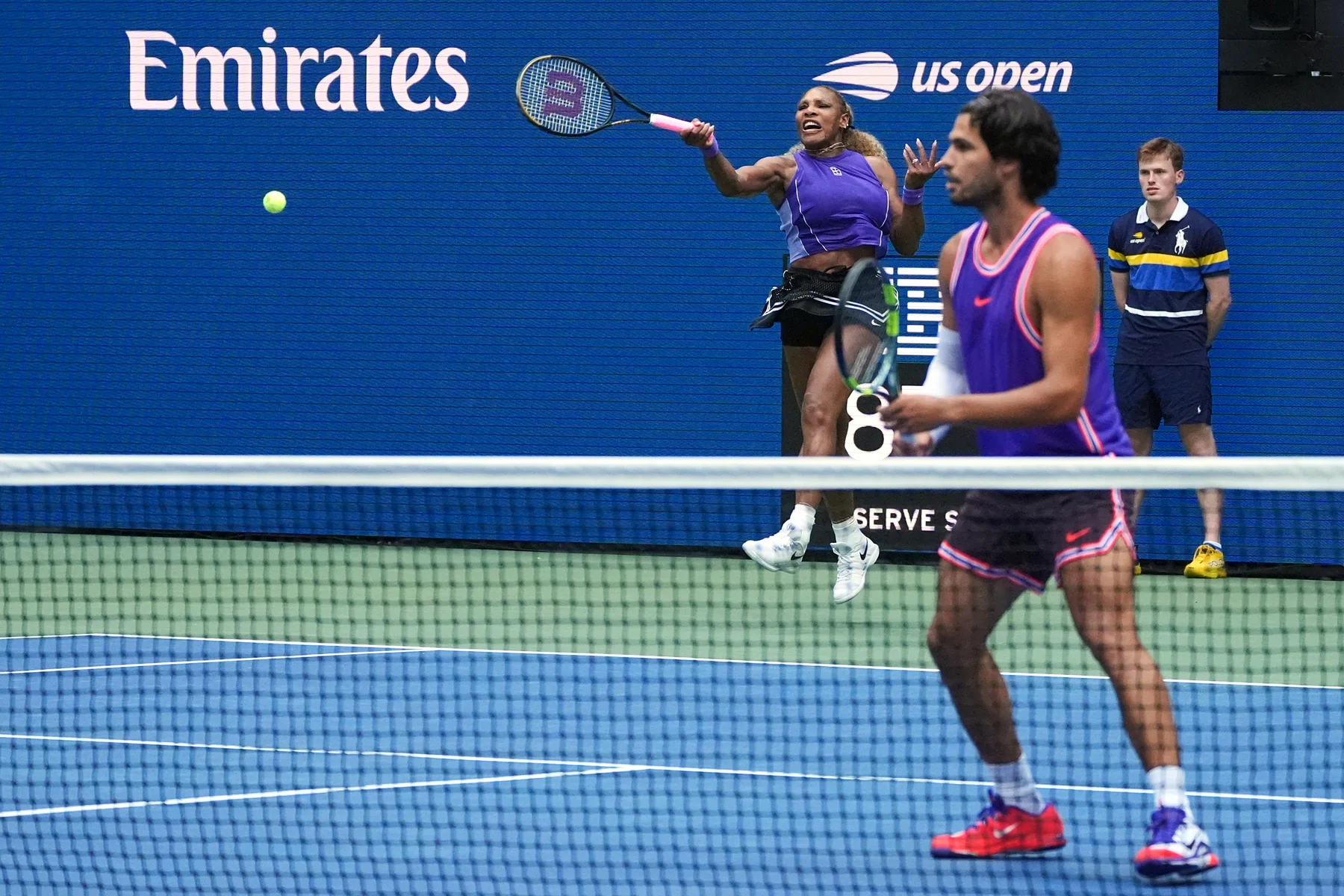
The quality of the opposition matters. Routliffe and Glasspool were not a ceremonial first-round pairing placed there to complete the show. Both had been ranked No. 1 in doubles, and they qualified by winning twice the day before, each time navigating the pressure of the compressed format. Beating them in straight sets meant Williams and Alcaraz had solved real doubles problems: protecting the middle, choosing when the man should cross, and keeping returns low enough that the first volley could not be punched away.
There was still an important warning in the performance. The pair's best points often depended on improvisation and superior athletic skill rather than repeatable team patterns. That is exhilarating in Arthur Ashe Stadium, and it was enough over 58 or 59 minutes, but it leaves less margin against opponents who serve to planned locations and move as a unit. The first round demonstrated why the partnership was dangerous; it did not prove it was fully formed.
Fans following how that win fitted into the 16-team competition can trace the path on the US Open draw page. The sporting takeaway is stronger than “two stars had fun”: after a nervous beginning, Williams and Alcaraz beat two seasoned doubles professionals by combining her economy with his explosiveness.
Why Bencic and Cobolli Won the Quarterfinal
Bencic and Cobolli won because they made their service games predictable for themselves and uncomfortable for the returners. The headline pairing never generated a break point, the clearest available statistic from the match. In a conventional set, a return team can spend several games reading direction and adjusting its position. In a race to four, repeatedly reaching 30 without creating a break chance is already expensive. Bencic's early ball-striking and Cobolli's first-strike weight kept Williams and Alcaraz reacting rather than choosing.
The 5-4(4) opening set was the match. It contained the contest's genuine balance: both teams protected serve, the crowd stayed involved, and a handful of points separated them. Bencic and Cobolli were calmer in the tiebreak because their patterns required fewer last-second decisions. Bencic could take a compact swing and redirect pace; Cobolli could serve, attack the next ball and close. Williams and Alcaraz, by contrast, were still negotiating who owned the middle and when Alcaraz should leave the baseline. Their improvisation produced spectacular moments but not the same percentage pattern under tiebreak pressure.
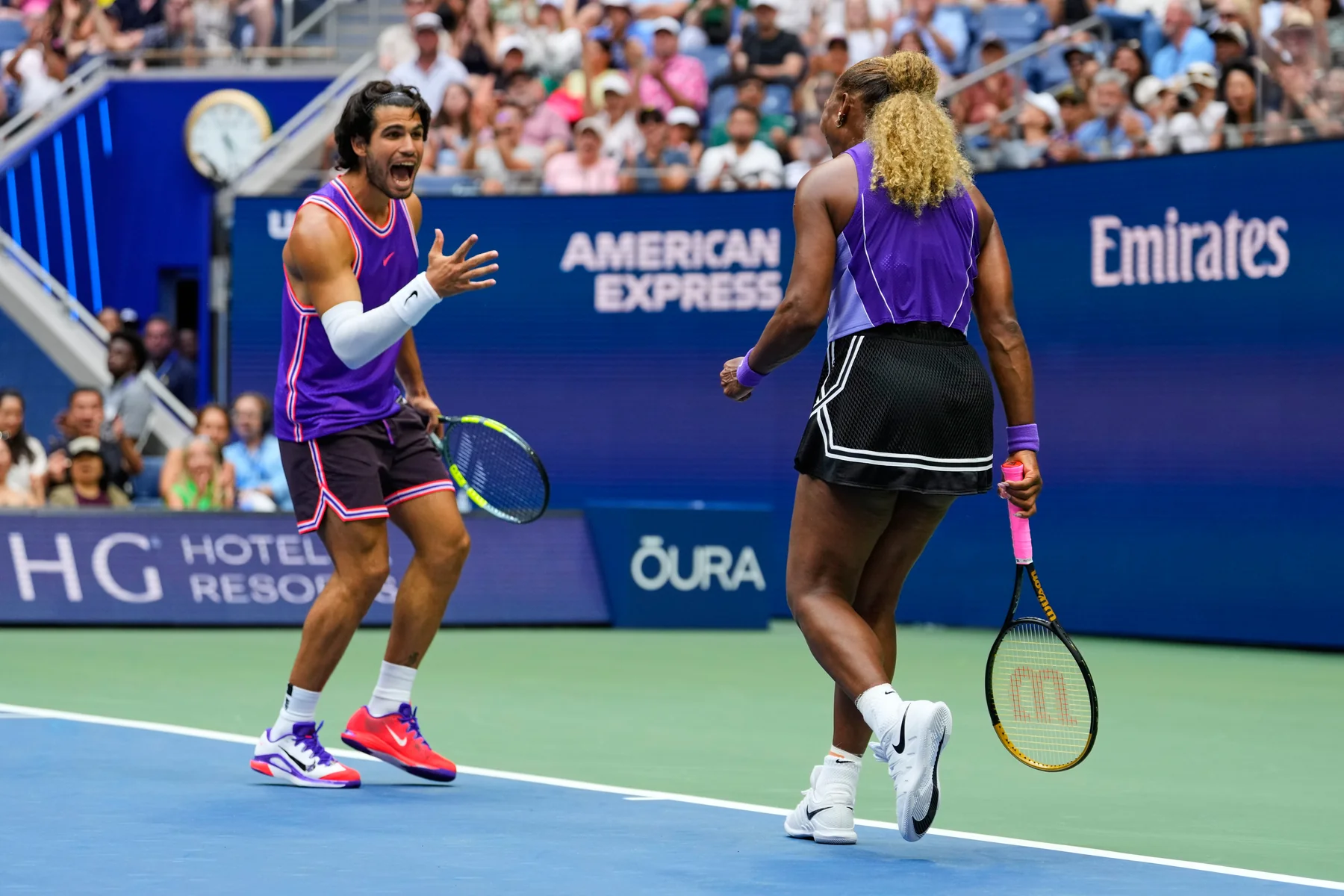
Once the tiebreak was gone, the second set moved brutally quickly. A 4-1 set can be only five games; falling behind by one break changes every return position and every no-ad point. The trailing team must become more aggressive, which opens angles for the server's partner. Bencic and Cobolli did not allow the occasion to make them passive. Cobolli eventually served out the victory at love, an emphatic finish to a 55-minute match.
Physical context probably shaped the rhythm but should not be used as a catch-all explanation. Williams was playing her second match of the day at 44, and Alcaraz was returning after months away with a wrist injury. Yet the decisive evidence on court was tactical: the winners offered no break points and managed the high-leverage tiebreak better. Bencic and Cobolli also had their own same-day workload after beating Taylor Townsend and Alexander Zverev 4-2, 4-2. Fatigue was shared; clarity was not.
That is why the result deserves to be treated as more than a famous pair running out of magic. The winning team solved the central doubles task—hold efficiently, control the middle and force the other pair to hit low-percentage returns. The updated score remains available on the US Open results page, but the enduring explanation is in those patterns.
What the Short-Set Mixed Doubles Format Changed
The short answer is that the format turned ordinary pressure points into match-defining events. From qualifying through the semifinals, the 2026 championship used best-of-three matches with sets played to four games, no-ad scoring at deuce, a tiebreak at 4-4 and a 10-point match tiebreak instead of a third set. Williams and Alcaraz never reached that deciding match tiebreak, but the rules shaped both of their matches: the scoreboard accelerated before either partnership could rely on the familiar rhythm of a six-game set.
Through the semifinals
Sets to four games, tiebreak at 4-4, no-ad scoring and a 10-point match tiebreak if teams split sets.
Championship match
Sets to six games, tiebreak at 6-6, no-ad scoring and a 10-point match tiebreak instead of a full third set.
No-ad scoring is especially important in mixed doubles because there is no low-stakes deuce point. At 40-all, the next rally decides the game. A server cannot erase a bad decision over several advantages, and a return team needs only one correctly anticipated serve to break. For a newly assembled team, that sharpens every uncertainty: who takes the ball through the middle, whether the net player poaches and which returner controls the first volley. Experienced pairs do not necessarily have more shot-making, but they often arrive at those decisions faster.
The difference between 4-4 and a conventional 5-5 is also larger than it appears. Williams and Alcaraz reached the first-set tiebreak against Bencic and Cobolli after staying level throughout the set. Losing it meant they were one short set from elimination. There was no additional return cycle in which to study Cobolli's serve or change position against Bencic. When the eventual winners broke early in the second set, the match was already in its closing phase.
The economics amplify the stakes. The 16-team field awarded $1 million to the champions, $500,000 to the runners-up and $120,000 per quarterfinal team. Those are serious competitive rewards attached to a television-friendly sprint. The format invites singles stars because it limits workload before the main draw, but it simultaneously rewards doubles habits: compact returns, decisive movement and pre-agreed patterns. That tension is the event's sporting identity, not an accidental side effect.
Fans can see how the compressed rounds connected on the US Open mixed-doubles draw. Read each 5-4 score as a full set decided at its designated tiebreak, not as an abandoned conventional set.
What Serena Williams' Return Meant at Flushing Meadows
Williams' return mattered because it connected two ends of an extraordinary New York career without pretending time had stood still. She first won a US Open title in 1998, taking the mixed doubles with Max Mirnyi at 16. Twenty-eight years later, she returned to the same tournament at 44 and partnered a champion from the generation that grew up watching her. The quarterfinal exit did not diminish that arc; the first-round win made it competitive rather than purely ceremonial.
Her US Open record explains the reception. Williams owns nine titles at the tournament: six in singles, two in women's doubles with Venus Williams and the 1998 mixed crown. Her last appearance in 2022 had been framed as an exit from professional tennis, making the sight of her again inside Arthur Ashe Stadium emotionally loaded. Yet nostalgia alone does not beat Routliffe and Glasspool. Williams still had to read elite serves, control returns and make reflex volleys in a format that punishes hesitation.
The useful way to judge this comeback is not by asking whether 2026 Serena reproduced peak singles Serena. It is by asking whether her decisions and technique still changed a high-level doubles match. In the first round, they did.
Doubles also gives an older champion a different competitive equation. Singles asks a player to defend the full court, recover repeatedly and sustain physical output over long matches. Doubles compresses the space and rewards anticipation, serve location, return timing and the ability to recognize a pattern before the ball arrives. Williams' compact mechanics and willingness to impose herself at net remain valuable under those conditions. Alcaraz supplied range and acceleration; she supplied a lifetime of knowing which ball mattered.
There are limits to what one afternoon proves. The second match exposed how quickly fatigue, timing and a new team's uncertain spacing can be punished. It also does not confirm a singles return or any future US Open schedule. Williams had not planned to play the 2026 women's singles event, and fans should resist turning every successful volley into a promise she has not made.
The more grounded conclusion is still powerful. Williams returned to the tournament where she won across all three disciplines, won a main-draw match against accomplished doubles opposition, and showed that her tennis intelligence remained visible even when the scoreboard finally turned. Fans can use the site's US Open player hub for the broader field, while treating this mixed-doubles run as a complete achievement in its own right.
What the Run Revealed About Alcaraz and the Revamped Event
For Alcaraz, the run was a useful return to competition, not a definitive fitness test. His opening double fault and own description of feeling nervous were unsurprising after more than four months away. He had not played since injuring his right wrist in Barcelona in April, a layoff that cost him Roland Garros and Wimbledon. Two short mixed-doubles matches placed the wrist under real serving, returning and reaction demands, but they could not simulate the repeated loading of a best-of-five singles match.
There were positive signs. After the first few games, Alcaraz accelerated through groundstrokes, covered space explosively and helped solve a team of former doubles No. 1s. He also completed two matches in one day without a reported stoppage. Those are meaningful competitive repetitions because practice cannot reproduce an Arthur Ashe crowd, a scoreboard or the consequence of a no-ad point. The limitations are equally clear: a combined afternoon of short sets tells us little about how his wrist and legs respond in the fourth hour of singles.
That distinction should guide fans into the main draw. The mixed event answered “Can Alcaraz compete again?” with a promising yes. It did not fully answer “Can he defend his level across seven rounds of best-of-five tennis?” His next confirmed assignment, recovery response and match length matter more than the visual appeal of a few explosive forehands. Use the US Open Order of Play for official court assignments and the full tournament schedule rather than assuming a time from a preview.
The partnership also clarified the argument around the revamped mixed-doubles championship. The 16-team, million-dollar event undeniably uses singles fame as its front door. Williams/Alcaraz and Djokovic/Sabalenka filled the stadium and pulled mixed doubles into the center of Fan Week. Yet the results did not reduce the competition to celebrity theater. Routliffe and Glasspool forced the headline pair to solve specialist problems; Bencic and Cobolli won with better team patterns; Siniakova and Patten qualified and eliminated a top-billed team.
That is the balance the tournament must protect. Star pairings bring an audience, but doubles craft gives the audience a reason to stay interested after the introductions. Williams and Alcaraz were compelling because their strengths were real and their vulnerabilities were legible. Their 1-1 run supplied a return story, a tactical lesson and a fair result. For one afternoon, the revamped event did what a good sporting format should do: create anticipation, then allow the court to complicate the script.
The Final Verdict on Serena and Alcaraz in New York
The pairing delivered exactly one afternoon of evidence: enough to show that Williams could still influence elite doubles, enough to give Alcaraz meaningful competition after injury, and enough to show why practiced formations survive the compressed format. Their quarterfinal finish was neither a failed spectacle nor the beginning of a proven championship team. It was a genuine 1-1 run whose best moments came when Serena's economy and Alcaraz's range complemented each other.
For fans, that is the satisfying part. The event supplied a famous photograph, but it also supplied a legitimate result. Bencic and Cobolli earned the last word by serving and positioning better when the scoring left no time to recover.
Loading comments…