2022 US Open Winners and Results: Alcaraz and Swiatek in New York
Complete 2022 US Open champions and final scores, with tactical analysis of Carlos Alcaraz's and Iga Swiatek's singles titles.
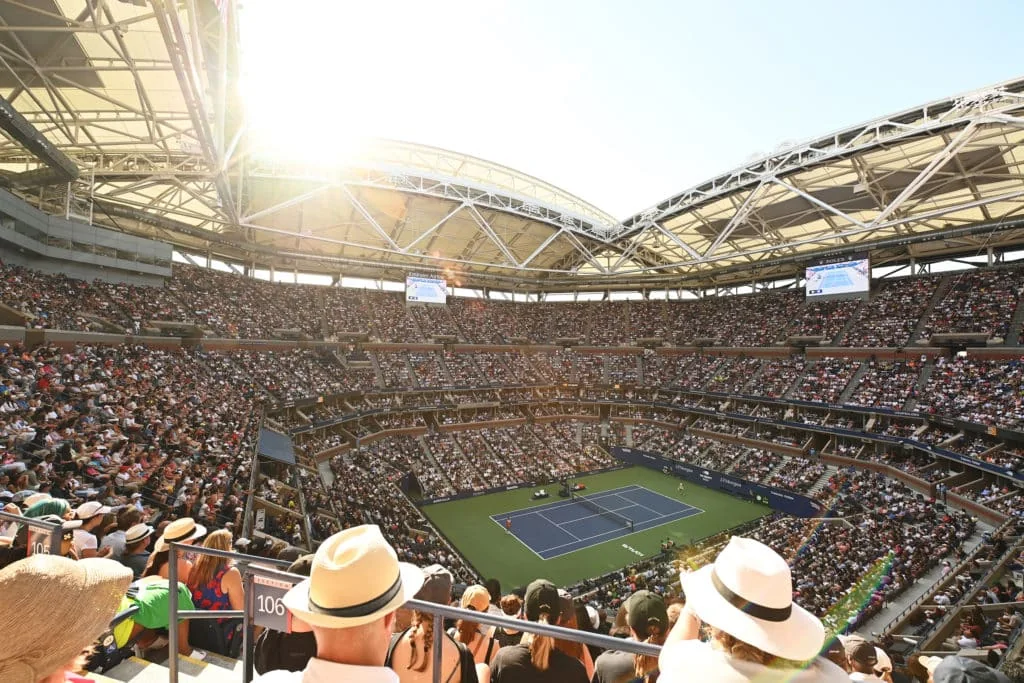
Complete 2022 US Open Champions and Final Scores
Carlos Alcaraz and Iga Swiatek were the 2022 US Open singles champions. Alcaraz defeated Casper Ruud 6-4, 2-6, 7-6(1), 6-3, while Swiatek beat Ons Jabeur 6-2, 7-6(5). The senior championship picture also includes three able-bodied doubles events and six wheelchair events, each with its own draw and scoring context.
| Event | Champion(s) | Runner(s)-up | Final score |
|---|---|---|---|
| Men's singles | Carlos Alcaraz | Casper Ruud | 6-4, 2-6, 7-6(1), 6-3 |
| Women's singles | Iga Swiatek | Ons Jabeur | 6-2, 7-6(5) |
| Men's doubles | Rajeev Ram / Joe Salisbury | Wesley Koolhof / Neal Skupski | 7-6(4), 7-5 |
| Women's doubles | Barbora Krejcikova / Katerina Siniakova | Caty McNally / Taylor Townsend | 3-6, 7-5, 6-1 |
| Mixed doubles | Storm Sanders / John Peers | Kirsten Flipkens / Edouard Roger-Vasselin | 4-6, 6-4, [10-7] |
Wheelchair champions
- Men's singles: Alfie Hewett def. Shingo Kunieda, 7-6(2), 6-1.
- Women's singles: Diede de Groot def. Yui Kamiji, 3-6, 6-1, 6-1.
- Quad singles: Niels Vink def. Sam Schroder, 7-5, 6-3.
- Men's doubles: Martin de la Puente / Nicolas Peifer def. Hewett / Gordon Reid, 4-6, 7-5, [10-6].
- Women's doubles: De Groot / Aniek van Koot def. Kamiji / Kgothatso Montjane, 6-2, 6-2.
- Quad doubles: Schroder / Vink def. Robert Shaw / David Wagner, 6-1, 6-2.
Square brackets identify a 10-point match tiebreak used instead of a full third set; parentheses record the losing player's points in a standard set tiebreak. Those conventions matter when comparing a mixed or wheelchair doubles final with singles. “Quad” is the wheelchair classification for players whose impairment affects at least three limbs, not another name for mixed doubles. Junior events, including the wheelchair junior competitions introduced at the 2022 US Open, are not folded into this senior list.
As a snapshot, the table shows a tournament balanced between arrival and continuity. Alcaraz won a first major; Ram and Salisbury defended their title; De Groot extended a New York dynasty; and Krejcikova and Siniakova filled the one missing major in their team résumé. The next sections explain how those outcomes happened. For live tournament editions, the site's US Open results page provides the current scores rather than this historical record.
Carlos Alcaraz's Five-Set Road to a First Major and No. 1
Alcaraz's 6-4, 2-6, 7-6(1), 6-3 victory over Ruud was the last stage of an endurance test that had already crossed ordinary limits. He went five sets against Marin Cilic in the fourth round, saved match point during a five-hour, 15-minute quarterfinal against Jannik Sinner, then needed another five sets and four hours, 19 minutes to hold off Frances Tiafoe. He had spent 20 hours, 19 minutes on court through six rounds and 23 hours, 40 minutes by the end of the final.
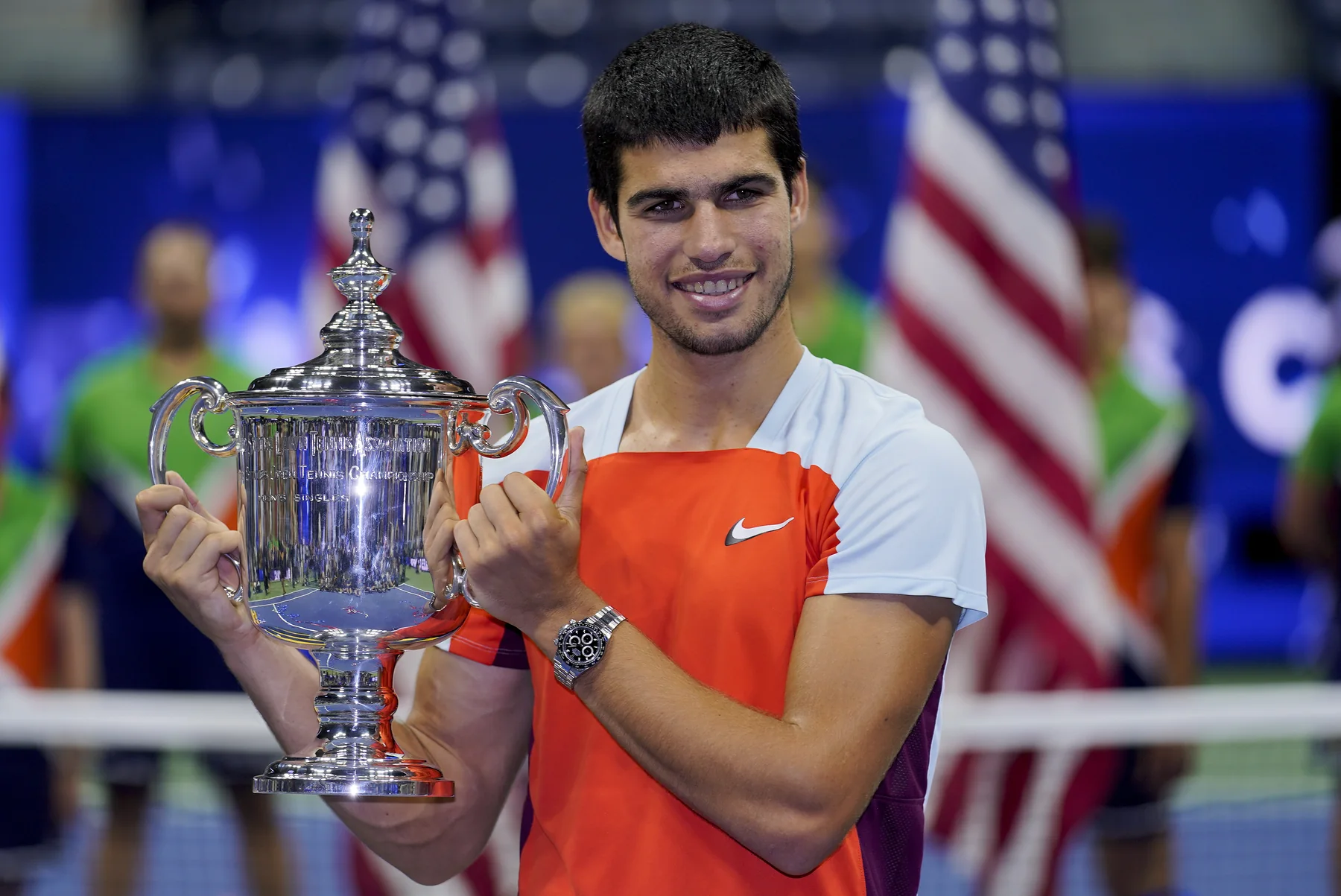
The Sinner match was the defining survival. Alcaraz trailed two sets to one, faced match point in the fourth and recovered from a break down in both the fourth and fifth sets. It finished at 2:50 a.m., then the latest conclusion in US Open history. That was not merely a stamina exhibition. Sinner's early ball-striking kept taking time away, so Alcaraz had to vary height, attack the forecourt and trust a drop shot even when tired. His willingness to change the rally's geometry prevented the Italian from settling into one relentless tempo.
That variation remained decisive in the final. Ruud stabilized after losing the opener and dominated the second with heavier forehand pressure. The match turned late in a 73-minute third set. Ruud held two set points with Alcaraz serving at 5-6; the Spaniard erased both, then overwhelmed the tiebreak 7-1. From there, his serve-and-volley choices shortened exchanges and moved Ruud away from his preferred forehand patterns. Across the tournament Alcaraz attempted 67 drop shots, a striking measure of how often he was willing to bring opponents forward before passing or lobbing them.
Sinner QF
5:15
Match point saved; 2:50 a.m. finish.
Final route
3 five-setters
Cilic, Sinner and Tiafoe before Ruud.
Reward
Major + No. 1
Both were decided by the championship match.
The ranking stake sharpened every decision. It was the first men's major final in which both players were chasing a first major title and the No. 1 ranking at once. Alcaraz, 19, became the youngest No. 1 in ATP rankings history and the first teenage men's major champion since Rafael Nadal at 2005 Roland Garros. Yet the most convincing evidence was not the age record; it was his ability to preserve explosive intent after accumulated fatigue. He did not win by slowing the tournament down. He kept choosing acceleration—returning forward, disguising the drop shot, closing at net—at moments when conservative tennis would have felt safer. Fans can trace the full sequence on the site's US Open draw.
How Iga Swiatek Solved New York and Beat Ons Jabeur
Swiatek's 6-2, 7-6(5) win was her first major title away from Roland Garros, and that context is essential. She had dominated the first half of 2022, including a 37-match winning streak, yet arrived in New York after uneven hard-court results in Toronto and Cincinnati. The US Open demanded that she build form inside the tournament. She recovered from a set down against Jule Niemeier in the fourth round and from 4-2 down in the deciding set against Aryna Sabalenka in the semifinal.
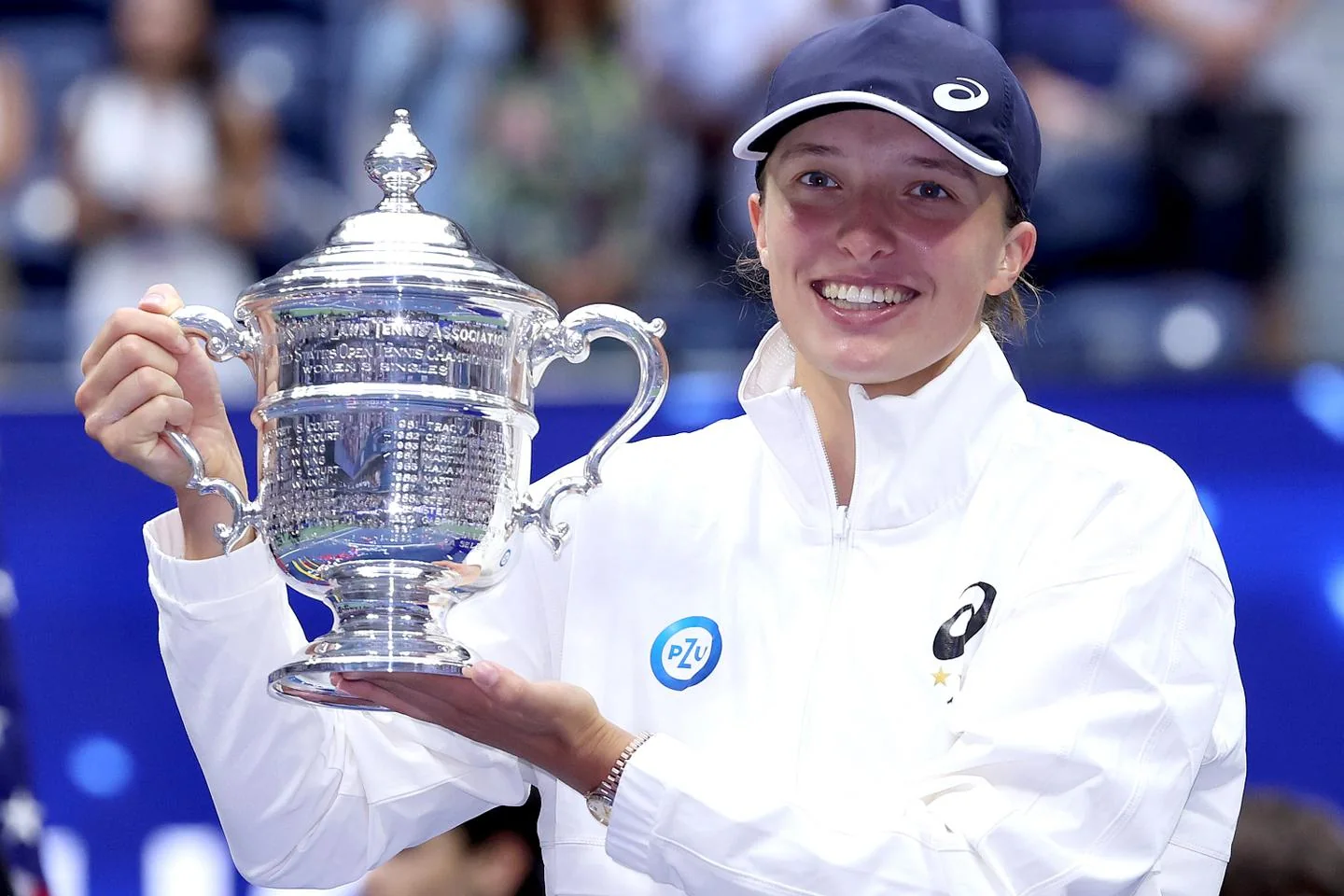
In the final, the return established authority immediately. Swiatek broke in Jabeur's first service game in both sets and rushed to 3-0 each time. Her ready position sat close enough to punish second serves, and her first groundstroke traveled deep through the center before she opened the angle. That sequence denied Jabeur the time required to disguise a drop shot or work toward net. Swiatek's forehand averaged 75 mph with 2,270 rpm during the tournament—both above US Open averages—while 85% of her backhands landed in court.
Jabeur did not disappear after the 30-minute opener. She increased the pace of her first attack, broke back twice in the second set and forced Swiatek to defend outside her preferred patterns. The statistics describe why the comeback stopped short. Swiatek won 43% of points in which she was classified as defending, compared with a 35% tournament norm. Jabeur had converted 69% of her attacking positions before the final; Swiatek held her to 57%. Defense here did not mean moonballs and waiting. It meant sliding into balance, sending the next ball deep and turning a losing court position neutral.
The second-set test
Swiatek twice surrendered a break lead, faced the variety of the tour's best change-of-pace player and trailed 5-4 in the tiebreak. She won the final three points. That finish is stronger evidence of hard-court adaptation than the one-sided first set.
Her title was also nationally historic: Swiatek became the first Polish player to win a US Open singles championship, while Jabeur was the first African and Arab woman of the Open Era to reach the New York final. Reducing the match to favorite versus underdog misses its level. They were the season's leading match winners and would occupy No. 1 and No. 2 after the tournament. Jabeur's slicing, touch and net instincts posed exactly the disruption Swiatek had to solve. Swiatek answered not by abandoning her identity, but by making it elastic—attacking returns when available and trusting her legs when control shifted. For current championship coverage, visit the site's US Open finals hub.
Doubles, Mixed Doubles and Wheelchair Winners
Rajeev Ram and Joe Salisbury's 7-6(4), 7-5 victory was a title defense built on role clarity. Both could serve and close, but Ram's heavy first ball and Salisbury's quick movement across the middle continually narrowed the returners' targets. They became the first men's team since Mark Woodforde and Todd Woodbridge in 1995-96 to win consecutive US Opens. That record matters because doubles partnerships live on fine timing: even elite teams rarely preserve health, form and shared decision-making across two full New York summers.
The women's final produced the sharper reversal. Caty McNally and Taylor Townsend led Barbora Krejcikova and Katerina Siniakova by a set and a break, with the Americans' first-volley aggression controlling the front of the court. The Czech pair adjusted return targets, made the middle busier and won 12 of the final 14 games for a 3-6, 7-5, 6-1 victory. New York supplied the only major title missing from their team collection. Because they also owned Olympic gold, the result completed both a career Grand Slam and a career Golden Slam; “career” means the trophies were accumulated across seasons.
Storm Sanders and John Peers also recovered from a set down, beating Kirsten Flipkens and Edouard Roger-Vasselin 4-6, 6-4, [10-7]. Their anticipation improved before their shot speed did: they survived long enough in return games to break at the end of set two, then trusted active movement in the match tiebreak. They were the first all-Australian team to win the US Open mixed title since Todd Woodbridge and Rennae Stubbs in 2001.
Wheelchair history in three directions
- Dynasty extended: De Groot won a fifth straight US Open singles title and completed a second consecutive calendar Grand Slam; she also won women's doubles with Van Koot.
- Grand Slam denied: Hewett beat Kunieda, who had won the season's first three majors, and collected his third New York singles crown.
- New quad leader: 19-year-old Vink won a second major singles title and partnered Schroder to retain quad doubles.
The men's wheelchair doubles final supplied the weekend's most dramatic dethroning. Hewett and Gordon Reid had won five consecutive US Open titles and served for a sixth at 6-4, 5-4. Martin de la Puente and Nicolas Peifer broke back without allowing a championship point, took the second set 7-5 and won the match tiebreak 10-6. De la Puente earned a first major title; Peifer won an eighth major doubles crown. That mixture of firsts and interrupted streaks is the right way to read the non-singles results. They were not an appendix to Alcaraz and Swiatek. They were separate elite contests with their own tactical decisions and historical stakes. The current results hub keeps those event classifications visible during the live tournament.
What the 2022 Results Changed in Tennis
The tournament did not single-handedly end one era and begin another, but it made the transition impossible to ignore. The men's semifinals contained four first-time major semifinalists for the first time since the inaugural U.S. Championships in 1881. The final put a first major and No. 1 ranking on the same court for both players. Alcaraz converted that opportunity, rose from year-end No. 32 in 2021 to year-end No. 1 in 2022 and became the first man outside Federer, Nadal, Djokovic and Murray to finish No. 1 since Andy Roddick in 2003.
That shift happened during Serena Williams' farewell fortnight. Her third-round loss to Ajla Tomljanovic was reported as the 1,014th and final match of a career that included six US Open singles titles. She left with 108 New York match wins. It is tempting to make the symbolism too neat—Serena exits, teenagers take over—but tennis generations overlap rather than exchange a baton on command. The meaningful link is the size of the standard: Alcaraz, Swiatek and the players around them were not merely popular new faces; they produced title-level results under the pressure Williams had helped normalize.
Men: a new ranking center
Alcaraz became the youngest No. 1 and youngest year-end No. 1 in ATP rankings history. Ruud's run carried him to No. 2 immediately after New York, evidence that the final changed the standings as well as the trophy cabinet.
Women: No. 1 confirmed
Swiatek finished 2022 with eight titles, a 67-9 record and 11,085 ranking points. Jabeur ended No. 2 after consecutive Wimbledon and US Open finals. New York clarified the top of the tour rather than scrambling it.
The tactical inheritance was just as important as the rankings. Alcaraz demonstrated that modern men's hard-court tennis can combine extreme baseline pace with frequent drop shots, net attacks and sprint defense. Swiatek showed that a heavy topspin forehand developed on clay could control a hard court when paired with aggressive return positioning and elite recovery. Neither champion fit the old caricature of a one-dimensional young power hitter. Their range forced opponents to solve several match types inside one contest.
Fans reading the 2022 results should therefore look for four layers. The score identifies the winner. The route measures accumulated difficulty. The ranking stakes reveal the pressure. The event label prevents different achievements from being confused: a career Golden Slam is not a calendar Grand Slam, and wheelchair quad is not mixed doubles. Applied together, those layers explain why 2022 survives beyond the trophy photographs. It was the fortnight when Alcaraz's potential became governing authority, Swiatek's clay dominance became all-surface credibility, and several doubles and wheelchair records changed hands at the same time. More context on those transitions is available in the site's US Open blog.
Loading comments…