Shelton vs Alcaraz at the 2026 US Open: Score, Highlights and Match Analysis
Shelton defeated defending champion Alcaraz in five sets after a 3:33 a.m. finish. This recap explains the score, tiebreaks and decisive patterns.
What was the final score of Shelton vs Alcaraz?
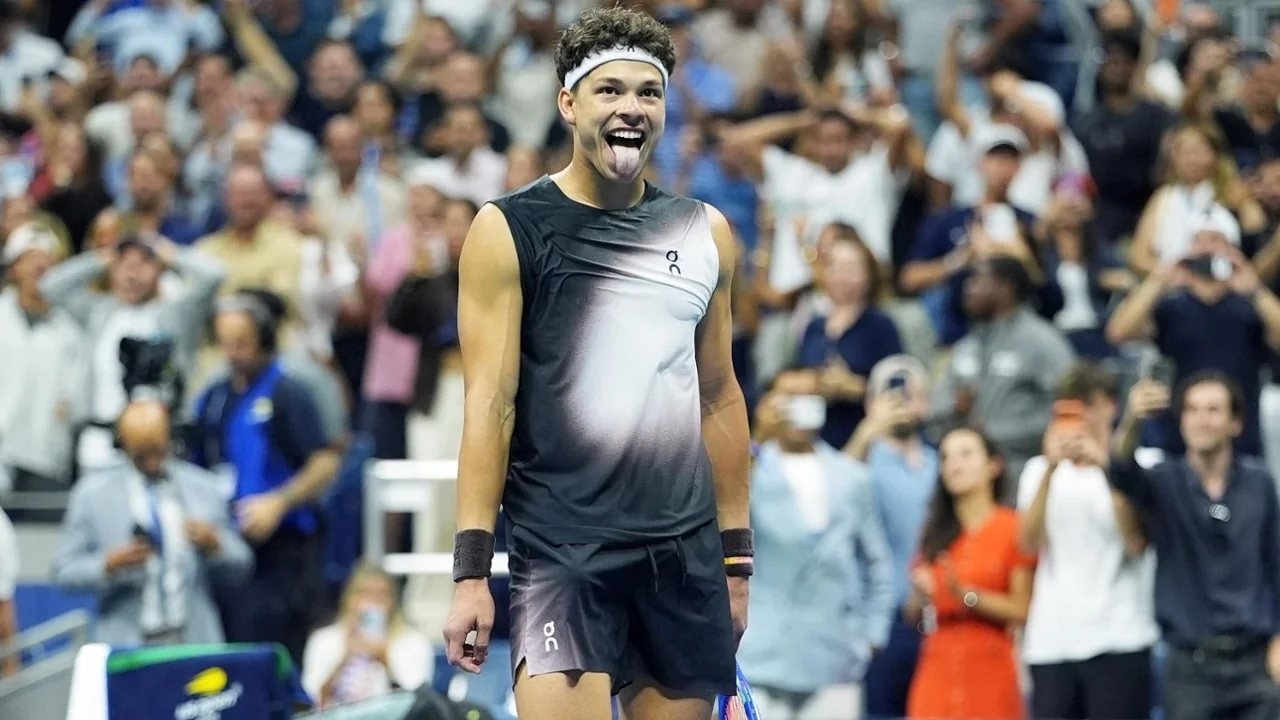
Ben Shelton defeated Carlos Alcaraz 6-7(5), 6-1, 6-3, 1-6, 7-6(7) in the men's singles quarterfinal of the 2026 US Open. Their four-hour, 28-minute match on Arthur Ashe Stadium began during the Tuesday, September 8 session and ended at 3:33 a.m. on Wednesday, September 9, New York time. The US Open's match report identifies that finish as the tournament's latest.
Shelton's score is listed first in every set below. He lost the opener, took two sets in succession, surrendered the fourth and won the deciding tiebreak. The victory ended Alcaraz's defense of the title he won in 2025 and moved Shelton into the semifinal. As of the 2026-09-29 information cutoff, this is a settled result; the completed results page shows how the rest of the draw finished.
| Set | Shelton games | Alcaraz games | Set outcome |
|---|---|---|---|
| 1 | 6 | 7 | Alcaraz won tiebreak 7-5 |
| 2 | 6 | 1 | Shelton broke three times |
| 3 | 6 | 3 | Shelton led 3-0 early |
| 4 | 1 | 6 | Alcaraz leveled the match |
| 5 | 7 | 6 | Shelton won match tiebreak 10-7 |
The parentheses in the two 7-6 sets represent different types of breaker. Shelton's first-set 6-7(5) means Alcaraz won a standard tiebreak 7-5. The final-set 7-6(7) means Shelton won a match tiebreak 10-7: the number in parentheses is the loser's seven points, not a statement that Shelton stopped at seven. The deciding format required at least ten points and a two-point margin.
This distinction matters because the scoreline alone conceals the match's shape. Alcaraz's first-set lead came from a late four-point run. Shelton took nine games consecutively during the middle phase, and Alcaraz then won the fourth set 6-1. Both had leads in the closing breaker. A useful analysis therefore needs the timing of those shifts, not just an adjective such as “epic.” The sections that follow trace the documented score changes, then test the interpretation against full-match statistics and official video.
How did Alcaraz escape with the first set?
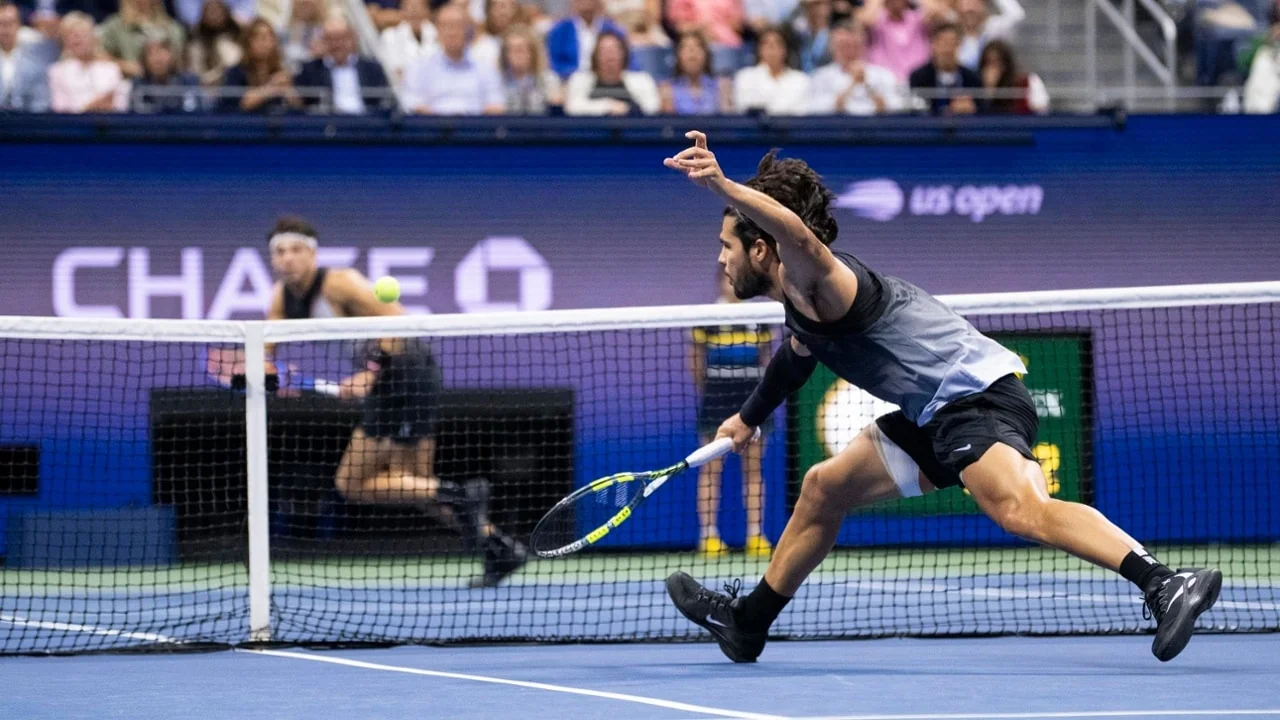
Alcaraz captured the first set by winning the final four points of its tiebreak. Shelton had led 5-3 and needed two points to win; Alcaraz took them all instead, finishing the breaker 7-5 and the set 7-6. It was a sharp reversal within a narrow opening set. It also shows why the eventual Shelton victory should be described as a comeback after losing the opener, rather than as a match he controlled from the beginning.
A set of narrow margins
The players traded late breaks before reaching six games each. The official US Open recap describes a tiebreak with several mini-breaks, which means points were won against the server as well as on serve. The report establishes the broad sequence, not a complete chart of individual rallies. Without that detail, the sound conclusion is that neither player made a late break stand up and that the deciding points in the opener changed hands quickly.
Shelton's 5-3 advantage deserves precise language. He was two points from taking the set, but he did not hold a set point at 5-3. This may seem a small distinction, yet it changes the reader's understanding of the escape. Alcaraz did not have to save an immediately losing point at that score; he had to sustain a run long enough to win four before Shelton won two. In a short standard tiebreak, that is still difficult, especially after each player had already lost a service game late in the set.
Four consecutive points in the tiebreak
From 3-5 down, Alcaraz reached 7-5 without surrendering another point. The completed scorecard independently confirms a 7-6(5) opening set for him. It is possible to understand that turn without guessing whether one return, volley or forehand caused it. Four straight points gave Alcaraz the set; the match card then shows he lost the next two sets 1-6 and 3-6.
That later sequence is why the opener is best read as one phase, not a forecast. Alcaraz showed the ability to win a tight scoreboard position, while Shelton showed he could immediately reset after missing a chance. For a reader following Alcaraz's wider US Open record, the first set fits his reputation for competing under pressure. This particular match, though, still required two more sets from him, and Shelton made those considerably harder to obtain.
Why did Shelton seize the middle of the match?
Shelton turned a lost opening set into a two-sets-to-one lead by winning sets two and three 6-1, 6-3. He broke Alcaraz three times in the second and started the third 3-0. His longest run reached nine straight games. Those facts give the middle phase a clearer explanation than “momentum”: Shelton kept taking service games from a player who had just escaped the first-set tiebreak, then built an early lead he could defend.
The second set is the sharpest statistical example. Three breaks mean Alcaraz's serve was under recurring pressure, not simply that Shelton hit an occasional unreturnable ball. The official report describes effective Shelton returns and angles, while noting a decline in Alcaraz's accuracy. It would require detailed point charting to say exactly which return position or groundstroke pattern produced each break, and the published recap does not provide that. The score and number of breaks are enough to establish the direction of play.
The third set followed with a 3-0 Shelton start. Alcaraz won three games before the set ended, giving it a more competitive 6-3 appearance, but the early deficit mattered. A player who leads by a break can afford to trade holds; the player behind needs to find a return game. Shelton kept sufficient control of his service games to prevent the set from returning to parity. After the tight first set and one-sided second, that early third-set cushion was what moved him one set from the semifinal.
Alcaraz's own reaction supports giving Shelton credit. He described his opponent as powerful and effective in different situations. He also acknowledged being physically tired after the third set, while saying he left the court healthy. His comeback from a wrist-related absence was part of the tournament context, but his comments do not establish that the injury caused the breaks in sets two and three. Reducing Shelton's run to Alcaraz's condition would go beyond the available evidence.
For followers of the men's singles draw, this stretch explains how an upset became possible after the favorite had already won a tense opening set. Shelton made Alcaraz defend his serve repeatedly, converted enough chances to take the second decisively, and protected an early third-set lead. The next question was whether he could finish before Alcaraz found another way back; the fourth set showed that the answer was no, at least for a while.
How did the fifth-set match tiebreak decide it?
The quarterfinal ended in a first-to-ten match tiebreak, which Shelton won 10-7. He had led the match two sets to one, yet Alcaraz forced the fifth with a 6-1 fourth. In the final breaker Shelton moved ahead 3-1, Alcaraz led 5-3, and the score returned to 6-6 before Shelton pulled away. The final score, 7-6(7) in set five, condenses a series of reversals into a notation that can look deceptively ordinary.
Alcaraz resets the contest
Alcaraz broke Shelton in the fourth set's second game and took the set 6-1. That was a complete scoreboard reset: the defending champion no longer had to win three sets in a row, only one. But a lopsided fourth does not guarantee an easy fifth. The official match account shows that Shelton remained close enough to threaten on return late in the decider.
At 4-4, Shelton reached break point on Alcaraz's serve and failed to take the game. The official account uses the plural “break points” without giving a count, so there is no basis to say exactly how many chances went unused. The missed opening mattered because a break at that stage could have let Shelton serve for the match. Instead, the set stayed level and reached six games all, triggering the match tiebreak. Both players had to make a new sequence of at least ten points, with a two-point winning margin.
Shelton closes after the lead changes again
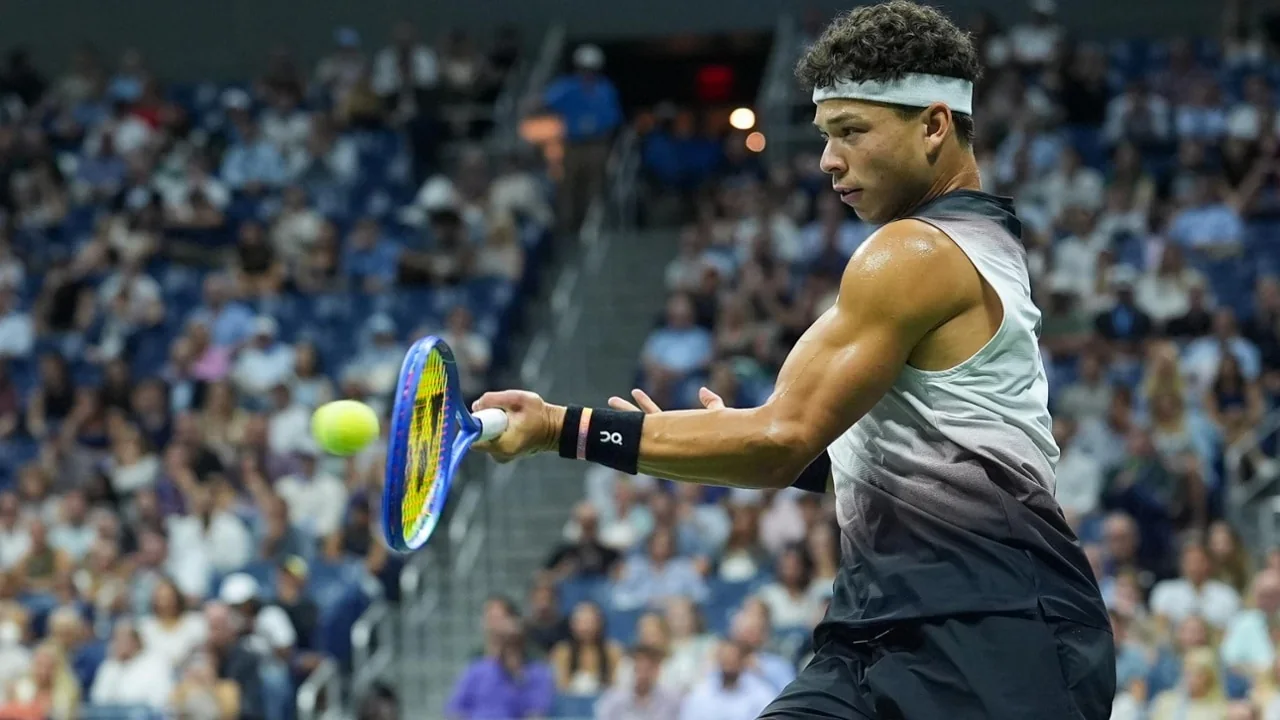
Shelton gained the first meaningful lead in the breaker at 3-1. Alcaraz then won enough points to move in front 5-3. They were level again at 6-6, after which Shelton earned a mini-break and reached 8-6. A mini-break means a point won against the server; in a breaker it can restore an advantage without changing a full service game. Shelton finished 10-7, ending the match with an ace measured at 146 mph at 3:33 a.m.
Alcaraz singled out Shelton's serve in his postmatch comments, explaining that such a delivery may prevent the returner from ever entering a rally. The ace supports that assessment for the final point. It does not prove every point in the breaker turned on serve; the changes from 3-1 to 5-3 and 6-6 show both players found ways to win points against the other. The score markers, rather than an assumed emotional swing, are the reliable account of how the lead moved.
The final results listing gives Shelton the win, correctly and concisely. The path to that result is more revealing: Alcaraz overturned the middle-set advantage, Shelton missed a chance at 4-4, Alcaraz briefly led the breaker, and Shelton finally turned a late mini-break into a two-point margin. That is what made the fifth-set tiebreak decisive.
Which match statistics explain Shelton's edge?
The match totals favor Shelton, but by less than the 6-1 and 6-3 middle sets might suggest. He landed 66% of first serves to Alcaraz's 64% and won 70% of first-serve points to Alcaraz's 69%. Those narrow gaps do not by themselves explain a five-set upset. The more useful contrast is opportunity: Shelton earned 16 break points and converted five; Alcaraz earned 11 and converted three. The Tennis.com completed match card supplies the totals.
Small service margins across five sets
Shelton also won 59% of second-serve points, against 57% for Alcaraz. He held 20 of 23 service games; Alcaraz held 19 of 24. Over one set, two percentage points might have little visible effect. Across a long contest, a few points falling in different games can create a break difference. The service-game numbers tell us the direct outcome: Shelton was broken three times while breaking Alcaraz five. They do not tell us which return position or rally length produced each one.
| Full-match statistic | Shelton | Alcaraz |
|---|---|---|
| First serves in | 66% | 64% |
| First-serve points won | 70% | 69% |
| Second-serve points won | 59% | 57% |
| Service games held | 20/23 | 19/24 |
| Break points converted | 5/16 | 3/11 |
The serve speeds need their own distinction. An official tournament facts report says Shelton reached 149 mph during this quarterfinal, the fastest serve recorded at the US Open through the quarterfinals. The winning ace was 146 mph in the match recap. Speed captures the top end of his weapon; the percentages and hold totals are better measures of how often that weapon helped him across the full match. Confusing the 149 mph high with the 146 mph ending would misstate a memorable point.
Break chances came in clusters
Shelton won five of 16 break points, roughly 31%; Alcaraz won three of 11, roughly 27%. Both men saved most of the opportunities they faced. The official account locates three Shelton breaks in set two alone, which helps explain the 6-1 score. The match card's aggregate cannot place every other break chance in a specific set, so it supports the overall pattern without providing a full game-by-game tactical map.
Shelton also won 43% of points when returning Alcaraz's second serve, compared with 41% for Alcaraz against Shelton's. That is another modest but relevant edge, not proof that second-serve returns alone won the contest. The men's draw shows the consequence of those margins: Shelton advanced, while Alcaraz's 18-match Grand Slam winning streak ended. The statistics illuminate a close contest in which breaks arrived at very different times.
Where are the official highlights, and what happened next?
The tournament offers a short quarterfinal highlights video and a separate extended highlights video. The official highlights article also embeds selected moments and repeats the score. These are the most direct official places to review the late-night quarterfinal. Their titles describe highlight packages, not a complete replay of a four-hour, 28-minute contest, and access to video can vary by location or device.
When watching, the useful guide is the changing scoreboard. Alcaraz escaped from 3-5 in the first-set tiebreak, Shelton won nine games in a row during the middle of the match, and Alcaraz answered with a 6-1 fourth set. In the final match tiebreak each player briefly led before Shelton finished 10-7 with an ace. A highlight edit can emphasize spectacular shots while shortening the stretches between them. The documented set sequence keeps those clips from being mistaken for a continuous account of every game.
The quarterfinal was the beginning of Shelton's last two matches in New York, not the end of his tournament. He next beat Frances Tiafoe 4-6, 6-3, 6-3, 7-5 in the all-American semifinal. The US Open semifinal report identifies this as Shelton's first Grand Slam final. That subsequent win confirms he was able to compete successfully again after the exceptionally late Alcaraz finish; it does not prove that the physical recovery was easy or automatic.
Alexander Zverev then defeated Shelton 6-3, 7-6(2), 5-7, 6-2 for the men's singles title, according to the official final account. Shelton was the runner-up, while Zverev was champion. The completed results page gives that overall picture. A reader searching for “Shelton vs Alcaraz highlights” may only see the upset and celebration; the later scores show how the victory fitted into an important but unfinished title run.
What made the quarterfinal memorable remains specific. Shelton lost an opener he had nearly won, took control in the middle, absorbed a fourth-set reversal and delivered the last strong serve in a deciding breaker. The official videos show selected scenes from that path. The final draw records the larger outcome: a breakthrough major final for Shelton and a 2026 US Open title for Zverev.
Loading comments…