Alcaraz vs Sinner: 2025 US Open Final Result and Match Analysis
Alcaraz defeated Sinner in four sets for his second US Open title. This recap explains the score, the crucial tactical turns and what the win meant.
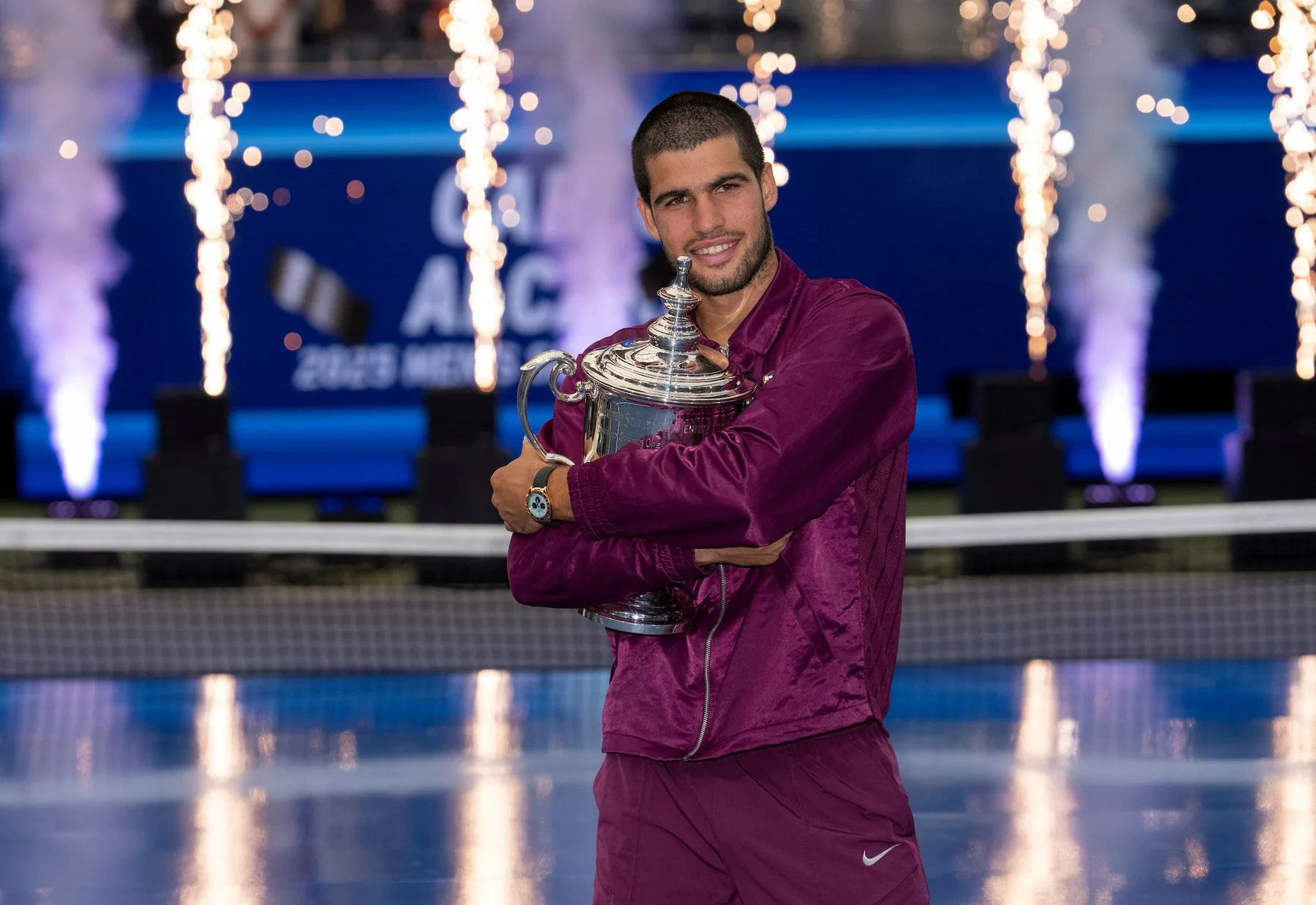
Carlos Alcaraz beat Jannik Sinner 6-2, 3-6, 6-1, 6-4 in the September 7, 2025 US Open men's singles final. His second New York crown also returned him to world No. 1. This retrospective follows the four-set shifts, the serve and return gap, and the choices that made Alcaraz's third-set response decisive.
What was the Alcaraz vs Sinner 2025 US Open final result?
Carlos Alcaraz defeated Jannik Sinner 6-2, 3-6, 6-1, 6-4 in the 2025 US Open men's singles final on September 7 at Arthur Ashe Stadium. The four-set victory took two hours and 42 minutes. It gave Alcaraz his second New York title and sixth Grand Slam singles title; Sinner finished as runner-up after winning the 2024 edition. The US Open's official final report is the source for the score and those title counts.
| Set | Alcaraz | Sinner | Match state |
|---|---|---|---|
| First | 6 | 2 | Alcaraz leads one set to love |
| Second | 3 | 6 | One set each |
| Third | 6 | 1 | Alcaraz leads two sets to one |
| Fourth | 6 | 4 | Alcaraz wins the title |
The middle scoreline can make the contest sound like a long period of even control. It was more jagged. Alcaraz broke in Sinner's opening service game and added another break to take the first set. Sinner then found a response in the second, becoming the first opponent to take a set from Alcaraz during his 2025 US Open run. The Spaniard immediately regained the initiative with a six-game third set before protecting one decisive break in the fourth. For readers who need the record rather than an interpretation, the site's finals hub is a useful starting point.
The result had a ranking consequence as well as a trophy ceremony. Alcaraz returned to world No. 1 the next day, ending Sinner's 65-week run at the top. That does not make the final a mathematical ranking tiebreak in every sense: points had accumulated across the season. It does mean the title match supplied the visible turning point of their fight for the top spot. Their 2025 New York meeting was also their third consecutive Grand Slam final, giving the score a wider rivalry context without changing the simple outcome.
When revisiting the match in 2026, keep the year attached. The 2025 score belongs to a final both men played. Sinner did not contest the 2026 US Open because of a right knee injury, and the 2025 result should never be presented as a 2026 head-to-head score. The distinction is especially useful for quick-answer searches where season labels are often dropped from a headline or snippet.
How did the four sets unfold?
The final moved through four clear phases: Alcaraz's fast first set, Sinner's genuine second-set adjustment, a sharp Alcaraz reset, and a fourth set decided by one break. The full score—6-2, 3-6, 6-1, 6-4—captures the size of those swings, but the timing of the breaks explains their force. Alcaraz took Sinner's opening service game in about nine minutes and added another break for 5-2. He served out the first set in 37 minutes, according to the official account.
Sinner's second-set answer
Sinner did not simply wait for Alcaraz to cool down. Early in set two he struck a passing forehand to break for 3-1, then protected that lead with five consecutive holds. It was the first set anyone had taken from Alcaraz at that year's US Open. That detail gives Sinner's response proper weight: the defending champion changed the direction of the match for a period against an opponent who had barely offered service openings all fortnight.
Sky Sports' courtside recap describes Sinner growing more assertive as the second set began. Its account and the official score agree that this was one successful break followed by composed service games, not a succession of chaotic swings. For fans rewatching the final, follow the rallies that earned the 3-1 break, then notice how rarely Alcaraz could create an immediate reply. Sinner had found a way to hold the baseline for long enough to even the contest.
Alcaraz's third-set reset and finish
The equal score after two sets did not last. Alcaraz broke for 2-0 in the third and again for 4-0; Sinner's forehand misses helped the second break. The Spaniard also escaped a 0-30 service game while the set was still taking shape. Those events matter more than a generic description of “momentum”: they show how quickly Alcaraz converted the first return opportunities after the interval and denied Sinner a path back into the set.
The fourth was tighter. Sinner saved an early break point, but Alcaraz broke for 3-2 and then held through to 5-4. Sinner resisted at the end, saving two match points before the third ended the final. The result record confirms a four-set Alcaraz victory, while the final games demonstrate that a 6-4 closer was not a passive procession. He still had to serve out the title against an opponent who had taken the second set and was prepared to hit through pressure.
This sequence is a useful antidote to oversimplified narratives. Alcaraz was the stronger player for most of the afternoon; Sinner nevertheless supplied a real tactical and scoreboard test. The decisive feature was Alcaraz's ability to restart his return pressure in the third set before the Italian could convert one set of control into a longer run.
Why did Alcaraz win the serve and return battle?
Alcaraz's service games were safer, and that freedom let him press Sinner's delivery repeatedly. The contrast was visible in both the percentages and the match's break-point economy. Tennis.com's match analysis records Alcaraz making 61% of first serves and Sinner making 48%. More importantly, Alcaraz won 83% of points behind a first serve and 57% behind a second. Sinner won 48% behind a second serve. The official recap says Sinner earned only one break-point opportunity all afternoon, which he took in set two.
The first-serve gap
First-serve percentage answers how often the opening delivery landed in; first-serve points won answers how often that landed ball helped win the point. The 61% versus 48% comparison is therefore not the same as 83% of first-serve points won. Both measures favored Alcaraz. More first serves made, and a high success rate behind them, meant Sinner received relatively few predictable second deliveries to attack. That helped Alcaraz hold quickly even as the quality of baseline exchanges rose.
The reliability had been a tournament-long feature. Across seven rounds, Alcaraz was broken only three times, according to the official final report. That is a full-event statistic, not a claim that he lost three service games in this final. Sinner supplied one of those breaks in the second set, yet could not reproduce it after Alcaraz tightened his service rhythm. Fans who watched Sinner's elite returning elsewhere in the season can see how much the first strike limited him here.
Return pressure on second serves
Sinner's 48% first-serve rate meant more points began with his second delivery. Alcaraz could step into those exchanges, change direction quickly and push the Italian to defend before he had settled on a first forehand or backhand. This does not mean every second serve was weak or every return was a winner. The statistical point is narrower and more persuasive: Sinner had to play a greater share of vulnerable service points against an opponent whose own serve was unusually secure.
The asymmetry explains how one set could be close in quality but the overall match still lean firmly to Alcaraz. Sinner needed to sustain pressure across an Alcaraz service game to reach even one break point. Alcaraz could generate repeated looks simply because Sinner was landing fewer first serves. The consequence showed most clearly in the third set, when early and repeated breaks converted a one-set-each score into a decisive advantage. The current men's draw tool tracks the subsequent tournament year; this comparison belongs specifically to the 2025 final.
There is a small but instructive reporting discrepancy: published recaps differ on Alcaraz's exact ace total. The analysis here rests on the consistent serve percentages and the official record of Sinner's lone break opportunity, rather than an unverified ace count. That is enough to explain why the winner could serve with more tactical freedom.
Which tactical choices decided the final?
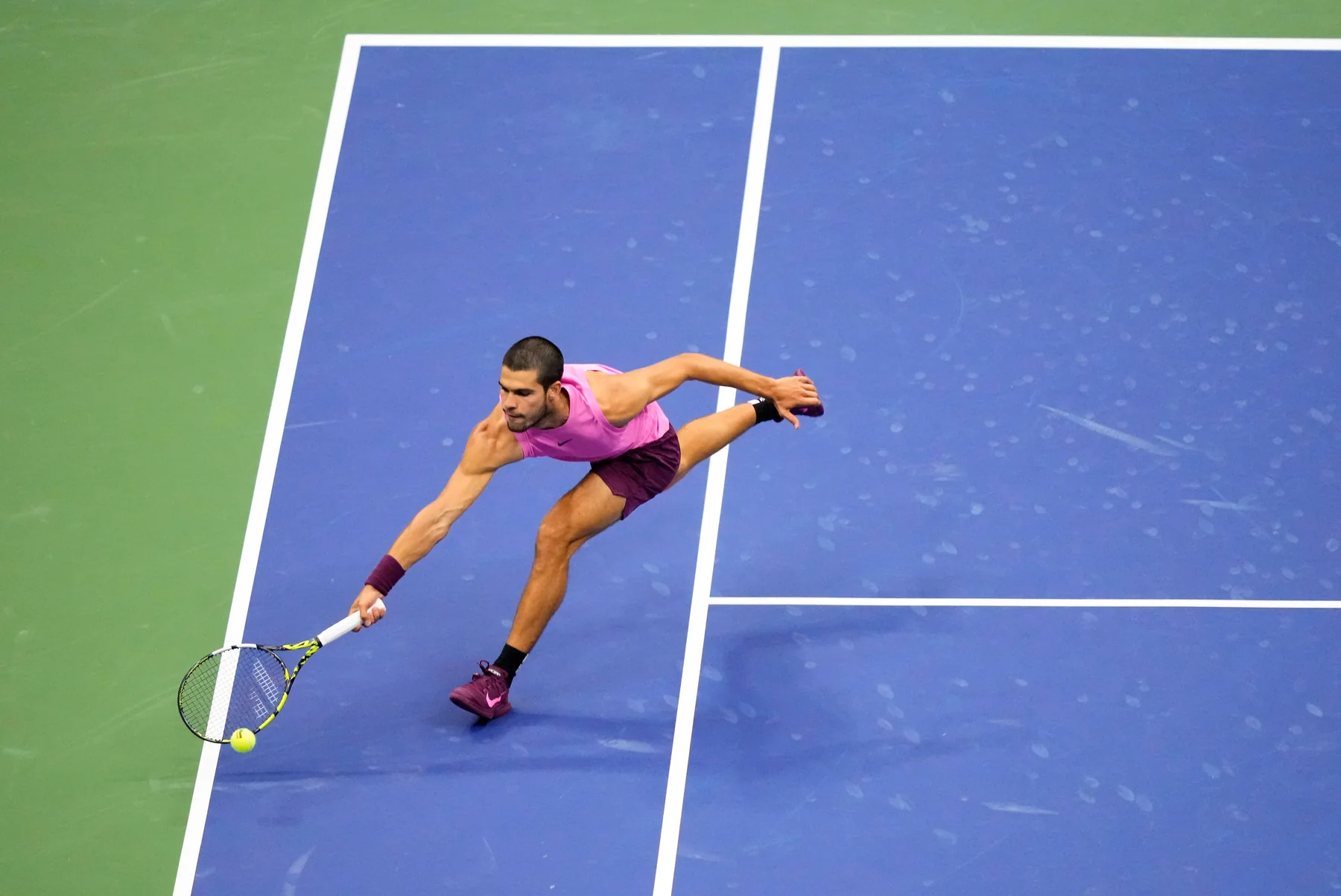
Alcaraz won by making Sinner solve different problems in the same rally. His stronger serve gave him a platform, but the distinction in open play was the range of directions and speeds he could choose without losing his attacking position. He drove forehands into Sinner's forehand court, changed the ball's height with a backhand slice, and advanced behind shorter replies. That variation interrupted the straight, hard baseline exchanges in which Sinner normally builds control.
The numbers support a measured version of that reading. Tennis.com reports 42 winners for Alcaraz and 21 for Sinner, while Alcaraz committed fewer unforced errors, 24 to 28. He won 20 of 27 points at the net. Those totals do not prove every net approach was strategically perfect; they show that aggressive movement forward was productive enough to complement his baseline hitting. His ability to attack without a large error cost was especially damaging to a rival who depends on making opponents play one more precise ball.
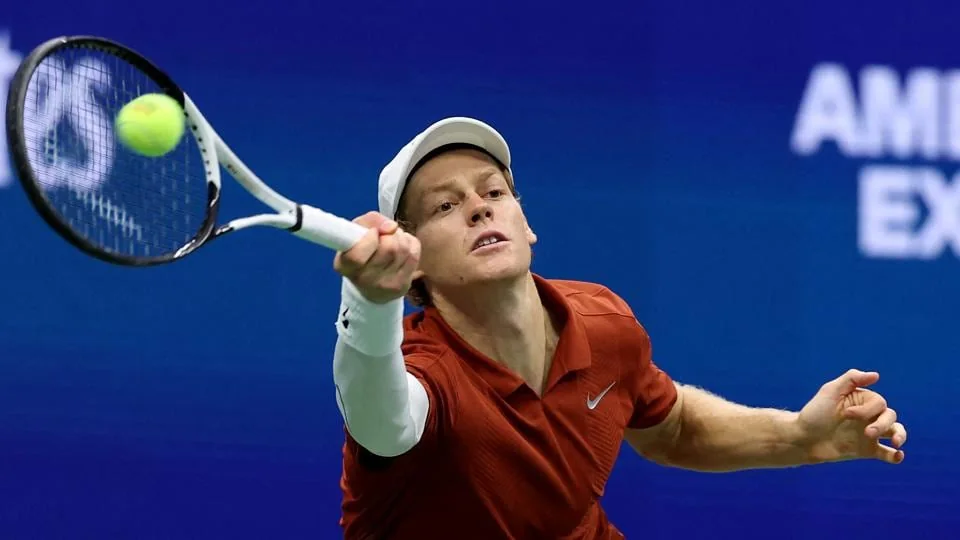
The second set is evidence that Sinner had an answer for part of the contest. In Hugh Clarke's detailed video-based analysis, Sinner redirected more play toward Alcaraz's backhand and used his own backhand down the line to alter the pattern. The official report's 3-1 break in that set shows the adjustment was reflected on the scoreboard. It took away some of the forehand initiative Alcaraz had enjoyed early. Calling the match a tactical sweep would ignore this interval.
Alcaraz's response was to reclaim initiative at the start of the third. Forehand angle and depth made Sinner defend from positions that kept him from setting his feet for his preferred first strike. The US Open recap describes two third-set breaks and a difficult overhead that helped Alcaraz escape danger on serve. A highlight of an improvised shot can be visually memorable, but the repeated return pressure mattered more: it gave Alcaraz the 6-1 set and forced Sinner to chase the match again.
Different shots served different purposes. A slice can bring a higher bouncing reply or disrupt timing; a drop shot makes a deep defender move forward; a heavy forehand into space makes the next stroke harder to organize. Alcaraz did not need to use each pattern constantly. The threat of several options made his high-speed forehand more difficult to anticipate. Sinner later discussed a desire to become less predictable, including using more serve-and-volley and drop shots. That is his own forward-looking assessment, not proof that one missing shot alone lost him the final.
On the Alcaraz player page, the result belongs among his 2025 accomplishments. For a fan studying this specific match, the key replay question is where each player stood after the serve or return. Alcaraz was most dangerous when he could take the first attacking position, and Sinner's best spell came when he denied that position by steering rallies away from the Spaniard's preferred forehand strike.
What did the win mean for the rivalry and rankings?
The 2025 final put Alcaraz back on top of the men's rankings and gave his rivalry with Sinner a third Grand Slam final in one season. It was Alcaraz's sixth major title and second at the US Open, following his first New York win in 2022. The US Open's account says he would become No. 1 on the Monday after the final, ending Sinner's 65-week hold on the ranking. The ranking description belongs to that September 2025 moment; it should not be read as a claim about their positions at any later date.
The trophy mattered partly because of who stood opposite. Sinner entered as the defending champion, having won in New York in 2024. Across 2025, the pair had met for the title at Roland Garros, Wimbledon and then the US Open. Alcaraz won the Paris match, Sinner the London match, and Alcaraz the New York match. Different surfaces and conditions exposed different strengths. Paris tested five-set recovery on clay; Wimbledon rewarded Sinner's grass-court execution; New York gave Alcaraz room to combine serve precision, forehand aggression and variation on a hard court. The three results provide context for the rivalry without reducing it to a single tally.
By the end of this US Open, Alcaraz and Sinner had claimed the previous eight men's Grand Slam titles between them, as both Sky Sports and the tournament noted. Alcaraz became the second-youngest man to reach six major titles in the Open Era. Those milestones explain why a four-set final that was shorter than their Paris encounter still carried enormous stakes. It decided a major championship, ended a title defense and visibly transferred No. 1 status.
It is tempting to convert a major final into a permanent verdict on which player is better. The evidence supports a narrower conclusion: Alcaraz solved Sinner more effectively on this court on September 7, 2025. Sinner's second set showed that he could disrupt the match, while Alcaraz's response showed the greater breadth and consistency of his solutions that afternoon. A future meeting would involve a new draw, new form and possibly new technical choices. The value of the final is in what it revealed, not in pretending those conditions repeat unchanged.
That year-specific framing became more important in 2026. Sinner withdrew from the following US Open before play because of a right knee injury, so there was no repeat final in New York. The player index and event archives can guide readers to each season. For this matchup, the historical line is clear: Sinner was the 2024 champion, Alcaraz beat him in the 2025 final, and the 2026 tournament did not give them another US Open score to compare.
Where can fans watch the 2025 final and check the record?
The best starting point for video is the US Open's 2025 Sinner vs. Alcaraz final highlights page. Its year and match title identify the correct contest. Availability of a video player can vary by browser or region, and an official highlights page should not be mistaken for a guaranteed full-match replay. For the definitive score and narrative sequence, use the tournament's match report. It is dated September 7, 2025 and names Alcaraz as the four-set champion.
Fans who want to study more than the short highlights can consult the Tennis Abstract charted-match page. It labels the match as the 2025 US Open final and confirms the same 6-2, 3-6, 6-1, 6-4 result. Its detailed tables offer a way to test specific questions about serve, return, rally length or shot direction. Charting is a separate analytical project, so match-level percentages should always be kept distinct from the seven-match tournament totals quoted elsewhere in this article.
A useful replay path is to start with the opening Sinner service game. Watch where Alcaraz stands on the return and how quickly he turns a neutral ball into a forehand attack. Next, watch Sinner's break to 3-1 in the second set: the Italian's rally direction and willingness to take a forehand chance show why he briefly changed the shape of the match. Then compare the first three games of the third set, when Alcaraz broke and immediately protected the lead. Finally, watch the fifth game of the fourth set and the last service game, which separate the decisive break from the act of serving out a major title.
These four checkpoints are more instructive than an undated collection of spectacular points. They map each tactical question to a documented change on the scoreboard. The site's results page is useful for current New York scores, but its main view may present the latest season. For this match, keep the 2025 date and four-set score attached to every video or statistics page you use. That is especially important after the 2026 US Open, in which Sinner did not play.
The final record is concise: Alcaraz won in four sets, became the 2025 champion and reclaimed No. 1. The replay adds the texture behind that record—Sinner's second-set answer, Alcaraz's response, and the unusual security of the champion's service games. If a clip omits those stretches, the official match report and charted data will keep the story anchored in the full contest.
Loading comments…